

What Does a Commercial Handyman Do? Services, Limits and When to Call One

What a commercial handyman actually does, how it differs from residential work, where a contractor or specialist takes over, and when to switch from one-off calls to a maintenance program.

Table of Contents

Cordless drill, hammer and hand tools on a wooden workbench

A commercial handyman handles the small and medium repairs and installs that keep a business property working: door closers and locks, drywall and ceiling patches, light fixtures and outlets, leaky faucets, shelving, furniture assembly, signage, storefront doors and floor transitions. It is the work that is too small for a general contractor and too varied for a single trade, done by technicians who know how commercial buildings operate.

The difference from a residential handyman is less about the tools and more about how the work is run: building access and security, scheduling around tenants and customers, commercial-grade hardware, written scopes, and a record of every job that a property manager can hand to an owner or an insurer.

This article explains what is usually included, where handyman work ends and a contractor or specialist takes over, and when it makes sense to move from one-off calls to a scheduled program.
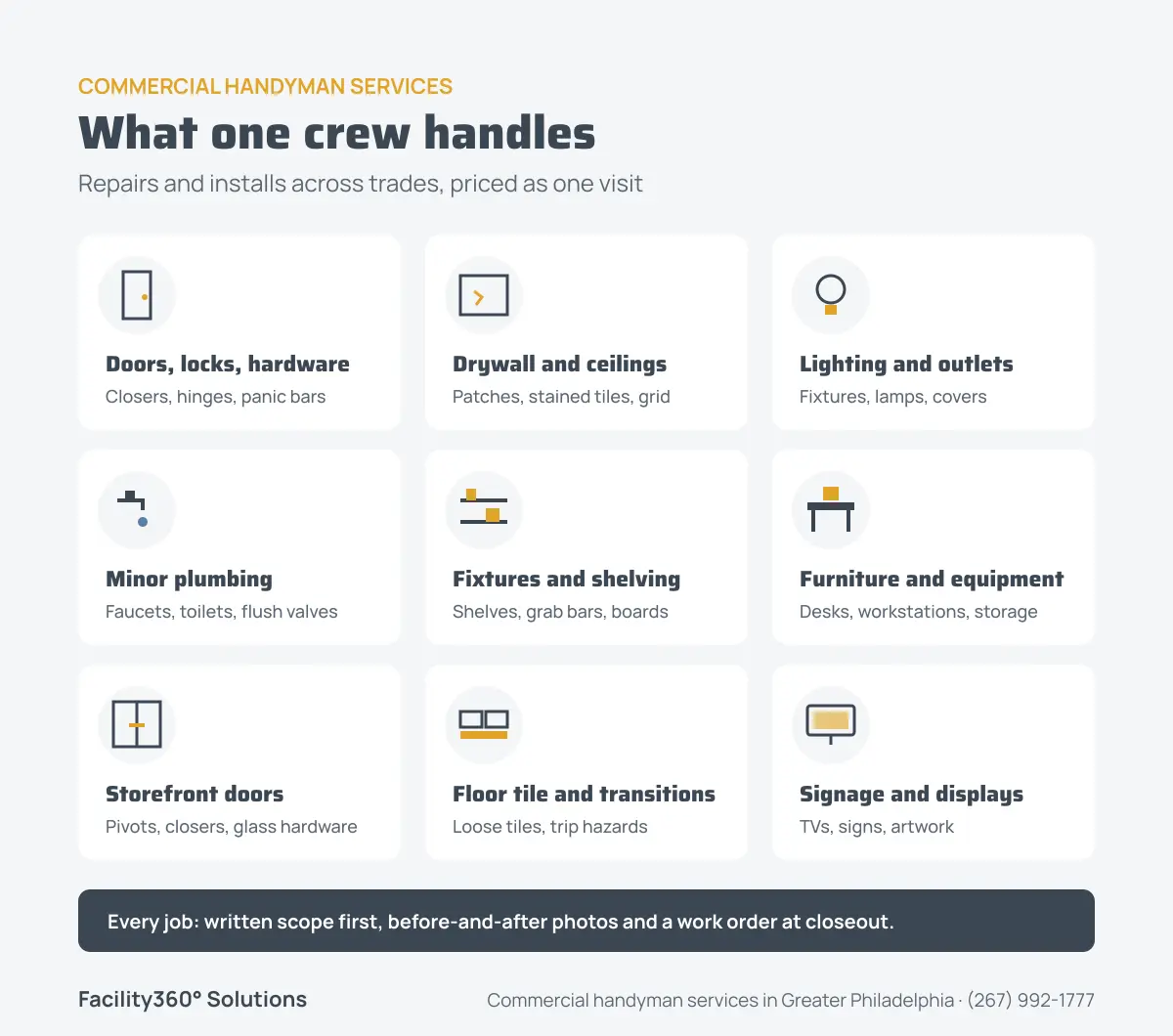
Nine areas a commercial handyman crew handles: doors and hardware, drywall and ceilings, lighting, plumbing, shelving, furniture, storefront doors, floors, signage
Repairs and installs across trades, handled by one crew and priced as one visit.

What a Commercial Handyman Service Usually Includes

The U.S. Bureau of Labor Statistics describes general maintenance and repair workers as people who fix and maintain machines, mechanical equipment and buildings, often doing many different tasks in a single day. In commercial buildings, that breadth is the whole point. A typical service covers:

AreaTypical jobsOur service page
Doors, locks and hardwareClosers, hinges, strikes, locks, panic bars, door sweepsdoor, lock and hardware repair
Drywall and ceilingsHoles, cracks, water-stained or broken ceiling tiles, grid repairdrywall and ceiling patching
Lighting and outletsFailed fixtures, lamps and drivers, damaged outlets and switch plateslighting and outlet replacement
Minor plumbingDripping faucets, running toilets, flush valves, supply lines, clogged sinksminor plumbing and faucet repair
Fixtures and shelvingShelving, cabinets, grab bars, whiteboards, mirrors, dispensersfixture and shelving installation
Furniture and equipmentDesks, workstations, storage, break room equipmentfurniture and equipment assembly
Windows and storefront doorsStorefront door closers and pivots, glass door hardware, window hardwarewindow and storefront door repair
FloorsLoose or cracked tiles, transition strips, trip hazardsfloor tile patch and transition molding
Signage and displaysWall-mounted TVs, signs, displays, artworksignage and display mounting

Most service calls mix several of these. A tenant moving out leaves holes in the drywall, a broken blind, a cabinet door off its hinge and a ceiling tile with a stain. A handyman crew fixes all of it in one visit instead of four trades on four different days.

How Commercial Handyman Work Differs From Residential

The repairs can look similar. The setting isn’t.

Access and security

Commercial jobs often mean signing in at a security desk, using a freight elevator, getting keys from a property manager or working in a suite while the tenant is at work. Technicians need to know how to do that without turning a 30-minute repair into a morning of phone calls.

Scheduling around people

A restaurant can’t have a drill running at lunch. A medical office can’t have a ladder in the waiting room during patient hours. Much commercial work happens early, late or on weekends.

Commercial hardware

Panic bars, heavy-duty door closers, storefront pivots, suspended ceiling grids, commercial faucets and flush valves are different from what is found in a house. A handyman who doesn’t work with them regularly will take longer and often fix the symptom instead of the cause.

Paperwork

Property managers need a certificate of insurance before anyone works in the building, a written scope before the job starts, and a record afterward. Our commercial handyman service closes every job with a work order and before-and-after photos.

Handyman, General Contractor or Specialist: Who to Call

The most common question from property managers is where handyman work ends. A simple way to think about it: handymen repair and replace what is already there; contractors build or change things; specialists service systems.
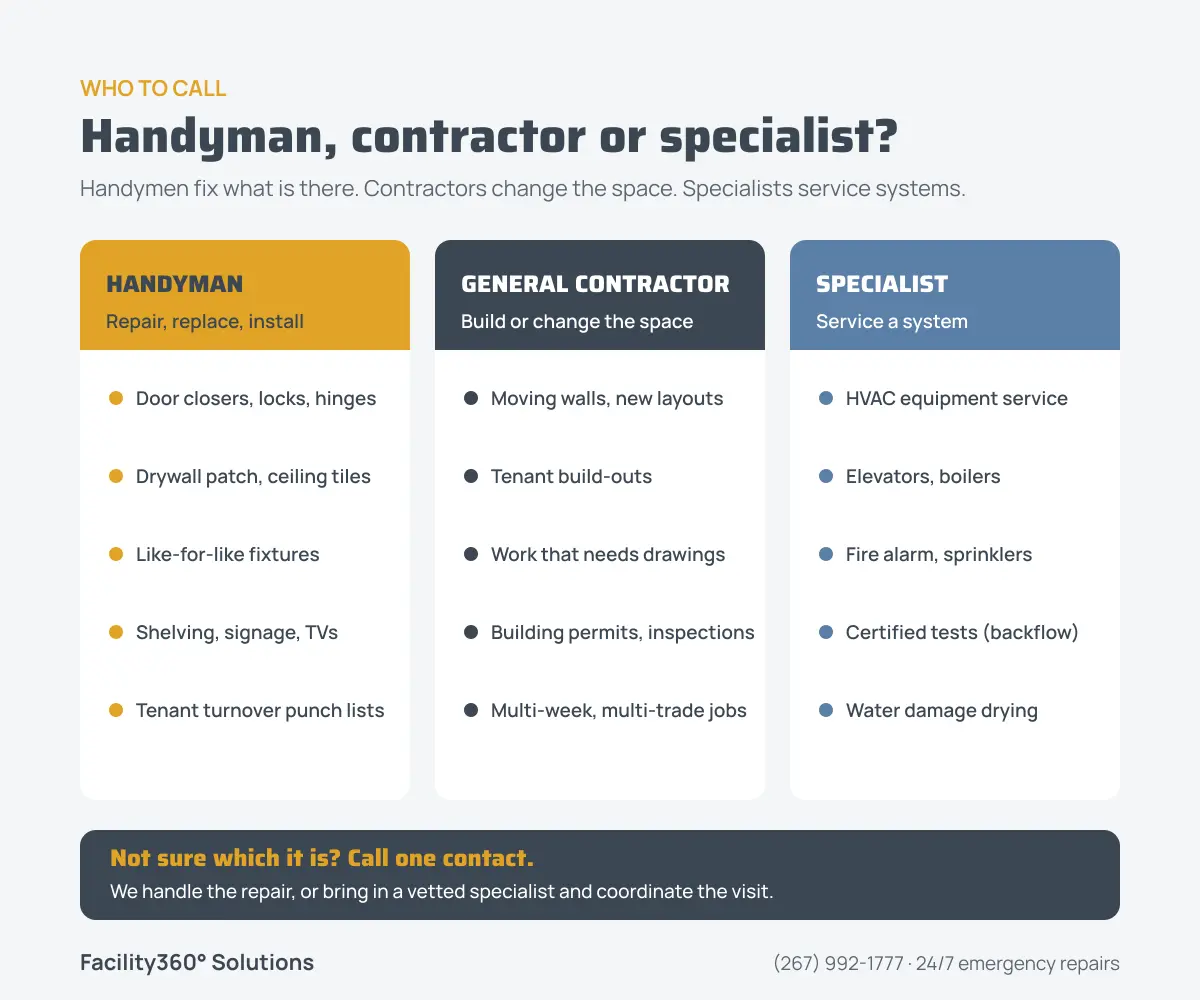
Comparison of when to call a handyman, a general contractor or a specialist for a commercial building
Handymen fix what is there, contractors change the space, specialists service systems.

Call a commercial handyman for

  • repairs to doors, locks, hardware, walls, ceilings, fixtures, floors and finishes;
  • replacing like for like: a faucet, a light fixture, a ceiling tile, a door closer;
  • installs that don’t change the space: shelving, signage, TVs, furniture, grab bars, whiteboards;
  • punch lists before a tenant moves in or after one moves out;
  • small items that keep coming up in a building and need someone who can handle all of them.

Call a general contractor for

  • renovations and tenant build-outs that move walls, change layouts or need drawings;
  • work that needs a building permit and inspections;
  • projects that run for weeks with several trades on a schedule.

Call a specialist for

  • full service or replacement of HVAC equipment, boilers and elevators;
  • fire alarm and sprinkler systems, and other equipment that needs a certified tester;
  • water damage restoration, where the building needs professional drying.

In practice, the lines blur. A ceiling repair turns up a leaking pipe; a door replacement needs a new frame. A good handyman service tells you when a job has moved past its scope and who should take it. At Facility360, when a job needs a specialist we bring in one we have worked with before and coordinate the visit, so you still have one contact.

How a Commercial Handyman Job Runs

  1. Request. You describe the problem or send photos. For a long punch list, a technician walks the site first.
  2. Written scope and price. You get a scope and price before work starts. Anything that turns up once the work begins is approved by you first.
  3. Scheduled visit. The work is scheduled around your tenants and staff, including after hours if needed.
  4. Closeout. You get a work order with tasks, materials, time on site and before-and-after photos.

Urgent problems skip the line. A broken entry lock, a leak coming through the ceiling or a broken storefront go to our 24/7 emergency repair team, with a technician on site in about an hour.

One-Off Calls or a Maintenance Program?

Handyman calls work well for buildings that need repairs now and then. One call, one job, no contract.

When the same building is calling every week or two, a scheduled program usually costs less and takes less coordination: regular visits, a checklist of preventive tasks, and repairs handled before tenants report them. That is our facility support services line, and our article on where preventive maintenance saves money explains how to tell when a building has reached that point.

Property managers with several buildings often use both: a program for the larger properties and handyman calls for the rest, all through one contractor.


How to Get the Most Out of a Handyman Visit

  • Send one list rather than one item at a time. A list is priced and scheduled as one visit.
  • Add a photo and location for each item: “3rd floor, men’s room, second stall” saves a lot of searching.
  • Note anything that needs parts ordered in advance, such as a specific lock, faucet or ceiling tile.
  • Arrange access before the visit: keys, alarm codes, security desk, freight elevator.
  • Tell the tenants. A short notice prevents the “nobody told us” call.

Repairs and small installs across trades: doors, locks and hardware, drywall and ceiling patches, light fixtures and outlets, minor plumbing, shelving and fixtures, furniture assembly, storefront door repair, floor tile and transition repair, and signage or TV mounting. Most visits combine several items from a list.

A handyman repairs and replaces what is already there and handles small installs. A general contractor manages renovations and build-outs that change the space, need drawings or a building permit, and bring several trades together over weeks. Many buildings use both: a handyman for ongoing repairs and a contractor for projects.

Yes. Much commercial work is scheduled early in the morning, in the evening or on weekends so it doesn't disrupt tenants, customers or patients. Facility360 schedules after-hours visits as needed.

Usually per job or per visit, based on a written scope. Sending a full list of repairs at once is the most cost-effective approach, because it is priced and scheduled as one visit. Buildings that need frequent visits often save with a scheduled maintenance program.

Yes, that is one of the most common jobs: patching and painting walls, replacing ceiling tiles, fixing doors and hardware, swapping fixtures and repairing floors. The whole list is priced together and closed out with a photo report.

You are told before any extra work starts and approve the change. If the job needs a specialist, Facility360 brings in one we have worked with and coordinates the visit, so you keep one point of contact.

Want a maintenance plan for your building?

Have a list of repairs building up? Send it over or call (267) 992-1777. We will price it as one visit and give you a written scope before work starts.
Picture of Sergey A.
Sergey A.

Owner of Facility360° Solutions, a commercial maintenance and repair company serving Philadelphia and 13 nearby suburbs. Sergey writes about the problems his crews see in offices, stores, restaurants, schools and medical buildings, and what property managers can do before a small repair turns into an emergency.

Request commercial service

Tell us what needs attention and we’ll get back to you with next steps.

For active emergencies, calling (267) 992-1777 gets the fastest response.

Request Service1-hour response
(267) 992-1777Call us 24/7Request Service1-hour response