
A magnetic lock (maglock) is an electromagnet mounted on the door frame header and a steel armature plate mounted on the door. While power flows, the magnet and plate hold together with several hundred pounds of force. Cut the power and the door opens. That is why every maglock on an exit door is fail-safe by design, and why the code cares more about how the power gets cut than about the lock itself.
Most maglock problems fall into two groups. Either the door won’t hold, which is a security problem, or it won’t release, which is a life safety problem. The first is usually alignment or power. The second is usually the release devices: the motion sensor, the push button, the switch in the panic bar or the fire alarm connection.
This guide explains how the parts work together, what the model codes expect on an exit door, the seven failures we see most often in Philadelphia-area buildings, and what not to do while you wait for a repair.
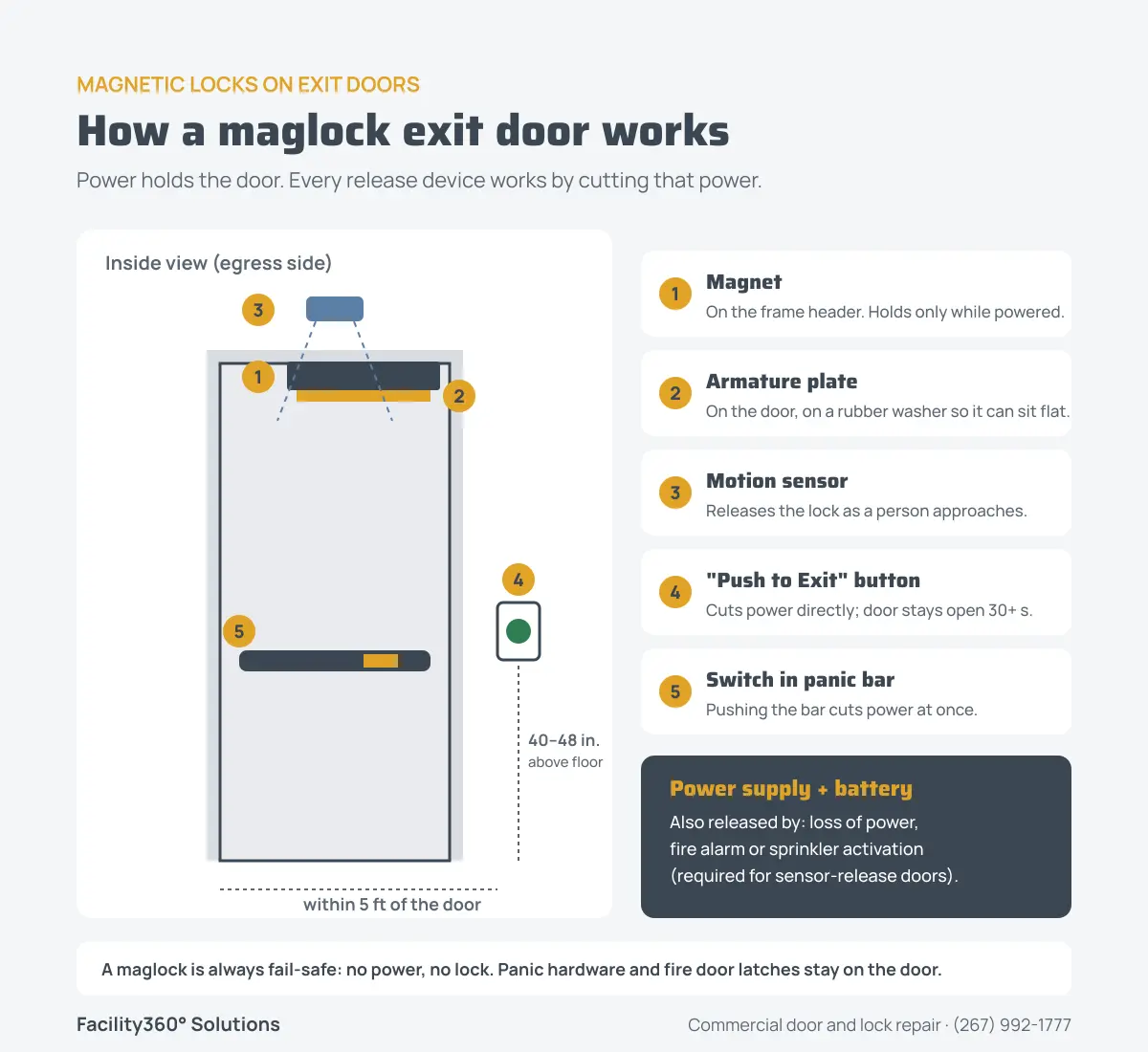
A typical commercial maglock is a long aluminum housing on the frame header with a coil inside. A steel plate on the door, called the armature, meets the face of the magnet when the door closes. Energize the coil and the plate is pulled flat against the magnet.
Holding force is rated in pounds. The common sizes are 600 lb for interior doors and 1,200 lb for perimeter doors. For scale, the Securitron M62, a widely used 1,200 lb model, draws 250 mA at 12 V DC or 150 mA at 24 V DC. That is less than a small LED fixture, so the lock itself rarely fails for electrical reasons. The parts around it do.
A complete maglock door usually has:
Because the door opens when power is removed, a maglock can’t be fail-secure. If the building loses power and the supply has no battery, the door is unlocked. That is acceptable for life safety, and it is why buildings that rely on maglocks for security put a battery backup on the power supply.
The International Building Code (IBC) and NFPA 101, the Life Safety Code, treat maglocks on egress doors as a special case, because a person leaving the building can’t open them without help from the electronics. Both codes allow them only in occupancies where they are permitted, and both describe two main ways to release them. A third type, delayed egress, adds a short delay before the door opens.
| System | How the door releases | What else must release it |
|---|---|---|
| Sensor release | A motion sensor above the door unlocks it as a person approaches | Loss of power to the sensor or the lock; fire alarm or sprinkler activation; a “Push to Exit” button 40–48 in. above the floor, within 5 ft of the door, that cuts power directly and holds the door unlocked at least 30 seconds |
| Door hardware release | A switch in the panic bar or lever on the door cuts power to the lock | The hardware must cut power directly and unlock the door at once; loss of power unlocks the door. No push button or fire alarm release is required by the model codes |
| Delayed egress | Pushing the bar starts an alarm; the door opens after 15 seconds (30 where officials approve) | Immediate release on fire alarm or sprinkler activation and on loss of power; a sign on the door explains the delay |
A few points come up again and again on service calls:
If you aren’t sure which type of system a door has, look above and beside it. A sensor over the door and a “Push to Exit” button next to it mean sensor release. Neither one, with a wire running into the panic bar, means door hardware release.
The lock is powered but the holding force is a fraction of its rating. The cause is almost always contact: the plate only touches part of the magnet face. A door that sags on its hinges, a frame that has shifted, a loose bracket or a closer that doesn’t bring the door fully shut leave a gap or an angle. Even a small gap cuts holding force sharply.
The fix: close the door slowly and look at the plate against the magnet. It should meet flat across the whole face. We tighten or rehang the door, adjust the closer so it pulls the door fully closed, and realign the magnet bracket or the plate.
Installers sometimes tighten the center bolt until the plate can’t move, or leave out the rubber washer because it looks loose. A rigid plate can’t settle flat against the magnet, so the lock holds weakly. Trimming the rubber washer has the opposite effect: manufacturers warn that it can make the plate slow to release.
The fix: remount the plate with steel washer, rubber washer, steel washer on the bolt, so it rocks slightly. A drop of thread locker keeps the bolt from backing out on a door that gets slammed.
Dust, grease, paint overspray and rust on the magnet or plate keep the two from meeting flat. Exterior doors and doors near loading docks are the usual victims.
The fix: clean both faces with a non-abrasive cloth and a mild cleaner. Don’t sand them or spray them with lacquer or lubricant. A badly pitted plate is replaced.
The door won’t lock at all, or locks weakly, and the problem may come and go. Causes include a failed power supply or battery, a loose terminal, a wire run that is too long for its gauge, or a 12/24 V setting that doesn’t match the supply.
The fix: measure voltage at the lock’s terminals with the door closed, not at the power supply. If the reading is low, work back toward the supply: connections, wire gauge, supply output, battery. We replace failed supplies and batteries and rerun undersized wire.
This is the dangerous one. When power is removed, a maglock should release at once. If it doesn’t, the cause is usually one of three things:
Securitron’s installation manual notes that even if the circuit that removes leftover magnetism failed completely, the lock would only feel “sticky” at around 5 pounds. A door that truly won’t open when power is cut is almost never residual magnetism.
The fix: treat it as an emergency. Prop the door open or post someone at it if the building is occupied, then call. We trace the release circuit and correct the wiring so each release device cuts power to the lock directly.
People walk up to the door and it stays locked, or they have to press the button twice. Sensors get bumped out of aim, set too narrow, or blocked by a new sign or display. Push buttons wear out or get wired through the access control panel instead of cutting power directly, which the code doesn’t allow on sensor-release doors.
The fix: test the sensor from where a person would actually approach, adjust the pattern and timing, and confirm the button cuts power on its own and holds the door unlocked for at least 30 seconds.
On sensor-release and delayed-egress doors, the fire alarm must unlock the door, and the door stays unlocked until the alarm system is reset. Two failures are common: the relay was disconnected during other work and nobody reconnected it, or the doors stay unlocked after an alarm because the reset sequence wasn’t followed.
The fix: test the release during the building’s next fire alarm test, with the alarm contractor present. We repair the door side and the relay wiring and coordinate the alarm side with your fire alarm technician.
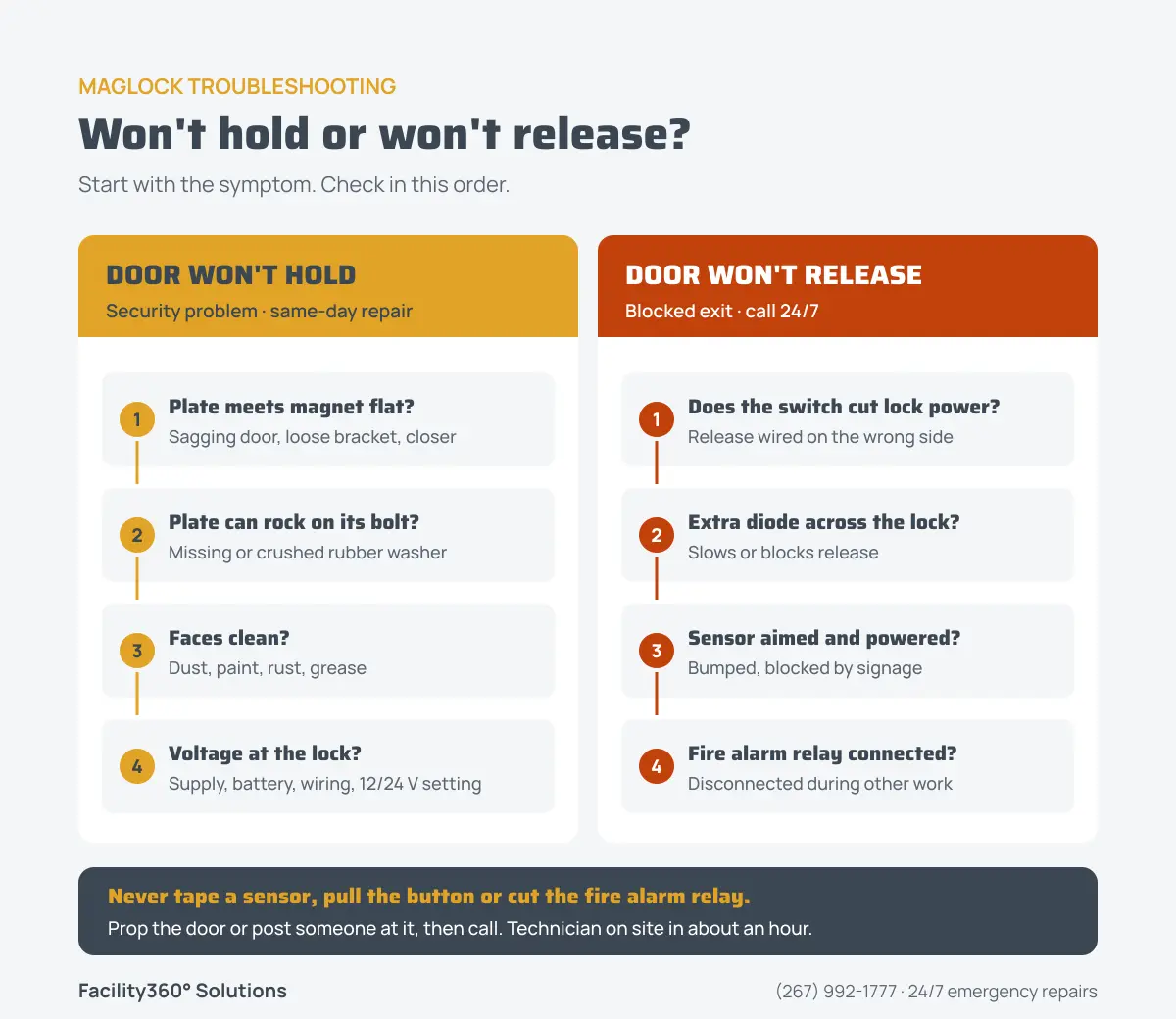
If an exit door won’t open from the inside, the building has a blocked exit until it is fixed. Our 24/7 emergency repair team handles it, with a technician on site in about an hour.
Write down anything that fails and send it with your next repair request. The same check works for the panic hardware on the door; our article on panic bars that won’t latch covers that side.
A door that won’t release is an emergency, day or night. A door that won’t hold is urgent: until it is fixed, the entrance is unsecured, and we schedule it the same day. Weak holding force, sticky release and a sensor that needs a second wave can usually wait for a scheduled visit.
On a magnetic lock repair call we handle the door itself, the magnet and plate, brackets, closers, power supplies, batteries, wiring, sensors, push buttons and door-mounted switches. When the fix needs programming in the access control panel or work on the fire alarm side, we bring in a technician we have worked with before and coordinate the visit, so you still have one contact. See our commercial door, lock and panic hardware repair service, and storefront door repair for glass doors with maglocks.