


When a panic bar stops latching, the cause is almost never the bar itself. In most cases the door has sagged and the latch no longer lines up with the strike, the door closer has lost its speed and the door stops short of the frame, or, on doors with vertical rods, the rods have gone out of adjustment and the bottom latch drags or misses its strike. Each of these is usually an adjustment or a part replacement, not a new device.
A door with panic hardware that won’t latch is more than an annoyance. On an exterior door it means the building can’t be secured at night. On a fire-rated door it means the door won’t hold back smoke and fire. And the quick fixes people reach for, like a chain, a padlock or a wedge, can make an exit door illegal to use.
Below are the seven exit device problems we see most often on commercial doors in Greater Philadelphia, what causes each one, and how it is fixed.
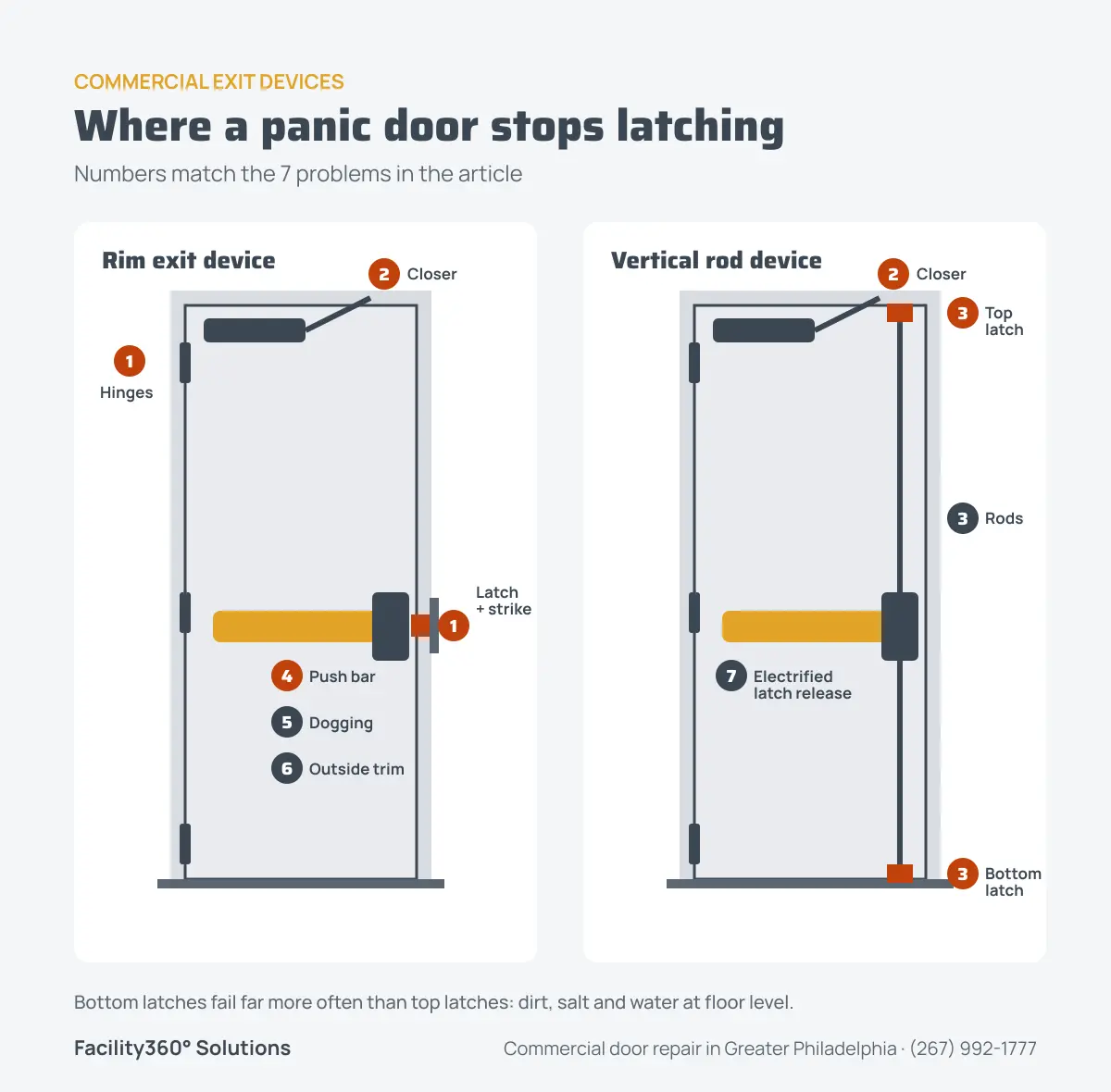
An exit device (panic bar, push bar, crash bar) releases the latch when someone pushes on the bar in the direction of travel. The two common types work differently, and that matters for troubleshooting:
Two other words come up a lot. Dogging means holding the latch retracted so the door works as push/pull during business hours. Fire exit hardware is a panic device listed for use on a fire-rated door; it has to latch every time the door closes.
What you see: the door swings shut, clicks against the frame and bounces back open, or you have to push it hard to make it catch. You may see a shiny wear mark on the strike or on the frame around it.
Why it happens: the door and the strike no longer line up. Heavy exterior doors pull on their top hinge every time they open, and over the years the hinge screws loosen or strip and the door drops at the latch side. Frames shift too, especially on older masonry buildings and on doors that get hit by carts and dollies.
How it’s fixed: tighten or replace the hinge screws first, using longer screws that reach the frame reinforcement if the original holes are stripped. That alone often lifts the door back into place. If the door still misses, the strike is adjusted or moved. Worn or bent strikes are replaced. Filing the latch or the strike to make it fit is a short-term fix that usually fails again within weeks.
What you see: the door closes slowly and stops an inch from the frame, or it closes in summer but not in winter.
Why it happens: the door closer controls the last few inches of travel, the latch speed. When that speed is set too slow, or the closer is losing fluid, the door doesn’t have enough momentum to push the latch past the strike. Temperature makes it worse: closer fluid thickens in the cold, which is why an exterior door that latched fine in October stops latching in January. Wind and air pressure from the HVAC system can do the same.
How it’s fixed: adjust the closer’s latch speed and sweep speed, and check the spring power. An oily film on the closer body or on the floor below it means the seals have failed. A leaking closer can’t be adjusted back to health and needs to be replaced. Fixing the closer often solves a latching problem that looked like a problem with the panic bar.
What you see: on a vertical rod device, the bottom latch scrapes the floor or the threshold when the door opens, leaves a groove in the floor, or doesn’t drop into its strike when the door closes. The door may latch at the top only, which leaves the bottom free to be pulled open.
Why it happens: on most vertical rod devices the top latch controls the bottom one. When the door is open, the top latch holds itself retracted and keeps the bottom rod lifted. If the rods go out of adjustment, the top latch no longer holds and the bottom rod drops and drags. Bottom latches also take a beating from dirt, salt and water at floor level, and they fail far more often than top latches.
How it’s fixed: the rods are adjusted to the manufacturer’s dimensions, top first, then bottom, and worn or bent bottom latches and floor strikes are replaced. Dirt and grit are cleaned out of the floor strike. On doors where the bottom rod keeps failing, the long-term fix is often a different device: two rim devices on a removable center mullion, or a less-bottom-rod version where the door allows it. That is a decision to make with the fire rating of the door in mind.
What you see: people have to throw their weight against the bar, it doesn’t spring back fully after it is pushed, or the door only opens if you push in a certain spot.
Why it happens: worn internal springs, dirt and corrosion inside the mechanism, a bar that was bent by impact, or a door that is binding in the frame so the latch is under pressure from the strike. Sometimes the device was mounted at the wrong height or not square to the door.
How it’s fixed: first, check whether the door itself is binding. If the latch is loaded against the strike, no amount of lubrication will help. Then clean and lubricate the mechanism as the manufacturer recommends, and replace damaged parts. This one matters for code as well as comfort. Model codes require a force of no more than 15 pounds on the bar to release the latch, and accessibility standards set lower limits for operating door hardware. A bar that takes a shoulder to open is a problem to fix soon.
What you see: the device won’t stay dogged during business hours, so the latch keeps catching; or the opposite, the dogging is stuck and the door can’t be secured at night.
Why it happens: the dogging mechanism wears out, the key or hex key gets lost, or on a vertical rod device the rods are out of adjustment so the latches can’t hold in the retracted position.
How it’s fixed: repair or replace the dogging mechanism, adjust the rods, and if staff are regularly dogging doors with a hex key, consider a cylinder dogging option so it is done with a key and tracked.
One important point: fire exit hardware has no mechanical dogging. If someone has jammed the latch, taped it, or added a screw to hold it back on a fire-rated door, that door can’t contain fire or smoke. Where a fire-rated door needs to work as push/pull during the day, electric dogging tied to the fire alarm is the usual option, so the latch projects as soon as the alarm goes off.
What you see: from the outside, the lever turns but the door doesn’t open, the key turns but nothing happens, or the door is unlocked from the outside when it should be locked.
Why it happens: the trim connects to the device through a spindle or tailpiece. If the trim was installed with the wrong function, the tailpiece is the wrong length, a cylinder cam is wrong, or the connecting parts are worn or broken, the outside and inside stop talking to each other. Vandalized and forced trim is common on rear and alley doors.
How it’s fixed: match the trim function to how the door should work (always locked, key unlocks lever, classroom function, and so on), replace worn spindles, tailpieces and cams, and rekey or replace the cylinder if needed. If the door is part of a keying system, keep it on the same keyway.
What you see: on doors with card readers or push-button openers, the latch pulls back when someone badges in and then drops before the door opens. Or it works in the morning and fails later in the day.
Why it happens: manufacturers point to a short list: the wrong power supply, wire that is too thin for the distance, or a mechanical problem that makes the motor or solenoid work too hard, often the same rod adjustment issue as in problem 3. The access control panel, door position switch or automatic operator can also be out of sync with the device.
How it’s fixed: check the mechanical side first. A device that latches cleanly by hand is much easier on the motor. Then check voltage at the device under load, the power supply rating and the wiring. If the access control system needs to be changed, that work is coordinated with your access control provider.
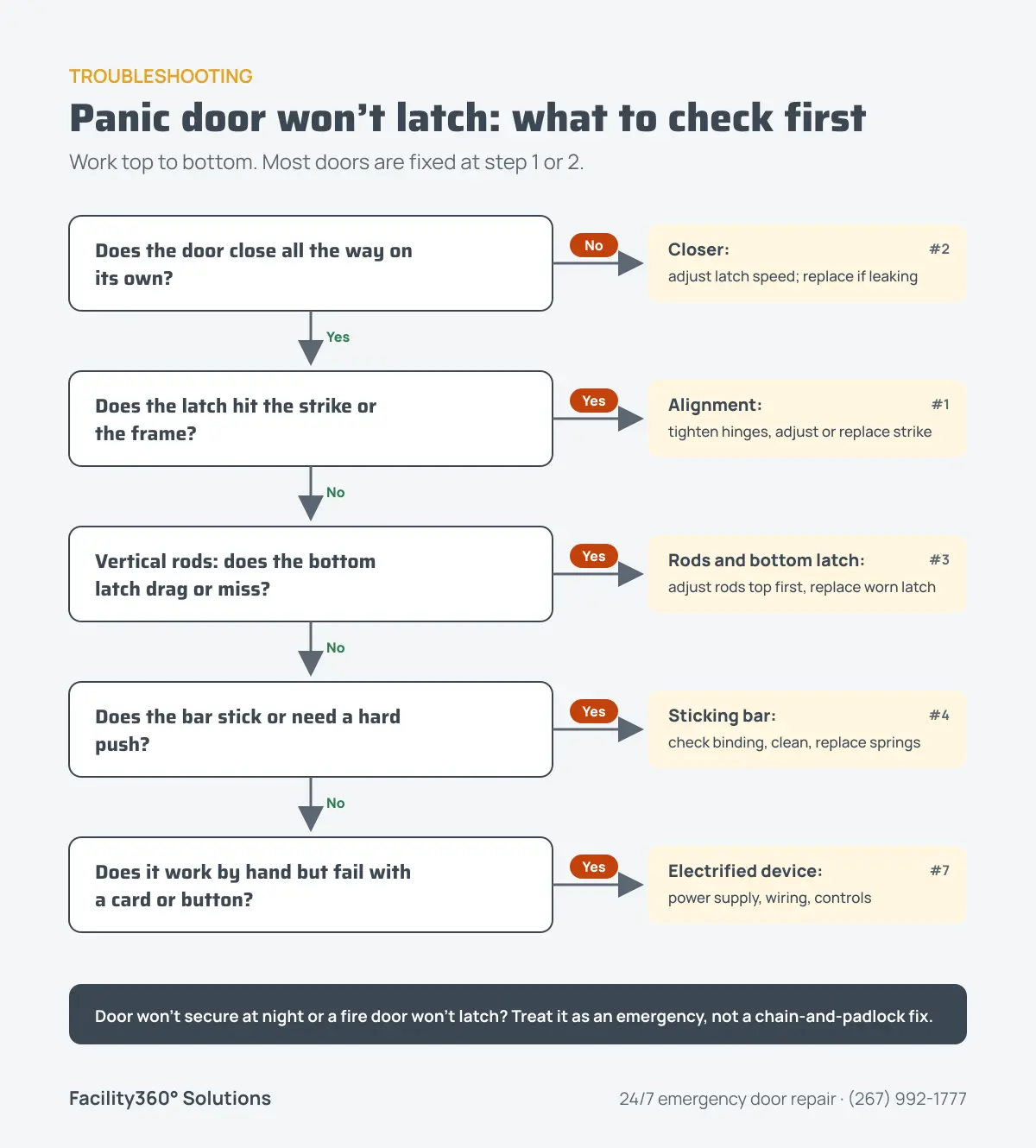
Most panic door problems start as a minor nuisance, and the temptation is to work around them. Several common workarounds make the door unsafe or non-compliant:
If a door is not secure at night, it is better to treat it as an emergency repair than to chain it.
Stairwell doors, corridor doors and doors to mechanical and electrical rooms are often fire-rated. You can usually find the label on the hinge edge of the door and on the frame. On these doors, the panic device must be fire exit hardware, the door must close and latch on its own every time, and the assembly must be inspected every year under NFPA 80, as well as after repairs. Keep the inspection report with your building records and fix the items it lists.
When we repair a fire-rated opening, we use listed parts, and we don’t modify the door in ways the label doesn’t allow.
Most of the problems above are repaired in one visit: adjustment, a new latch, a new closer, new strike or trim parts. Replacement makes sense when the device is damaged beyond repair, when parts for an old model are no longer available, when the device doesn’t meet the needs of the door (for example, ordinary panic hardware was installed on a fire-rated door that needs fire exit hardware), or when a vertical rod device keeps failing and a different configuration would solve it for good.
Our door, lock and hardware repair service covers exit devices, closers, locks, strikes, hinges and trim on commercial doors. A door that won’t lock or a blocked exit is treated as an emergency: we respond 24/7, with a technician on site in about an hour. Routine adjustments can be added to a scheduled visit, and on buildings we maintain, exit doors are checked as part of the regular maintenance checklist.