

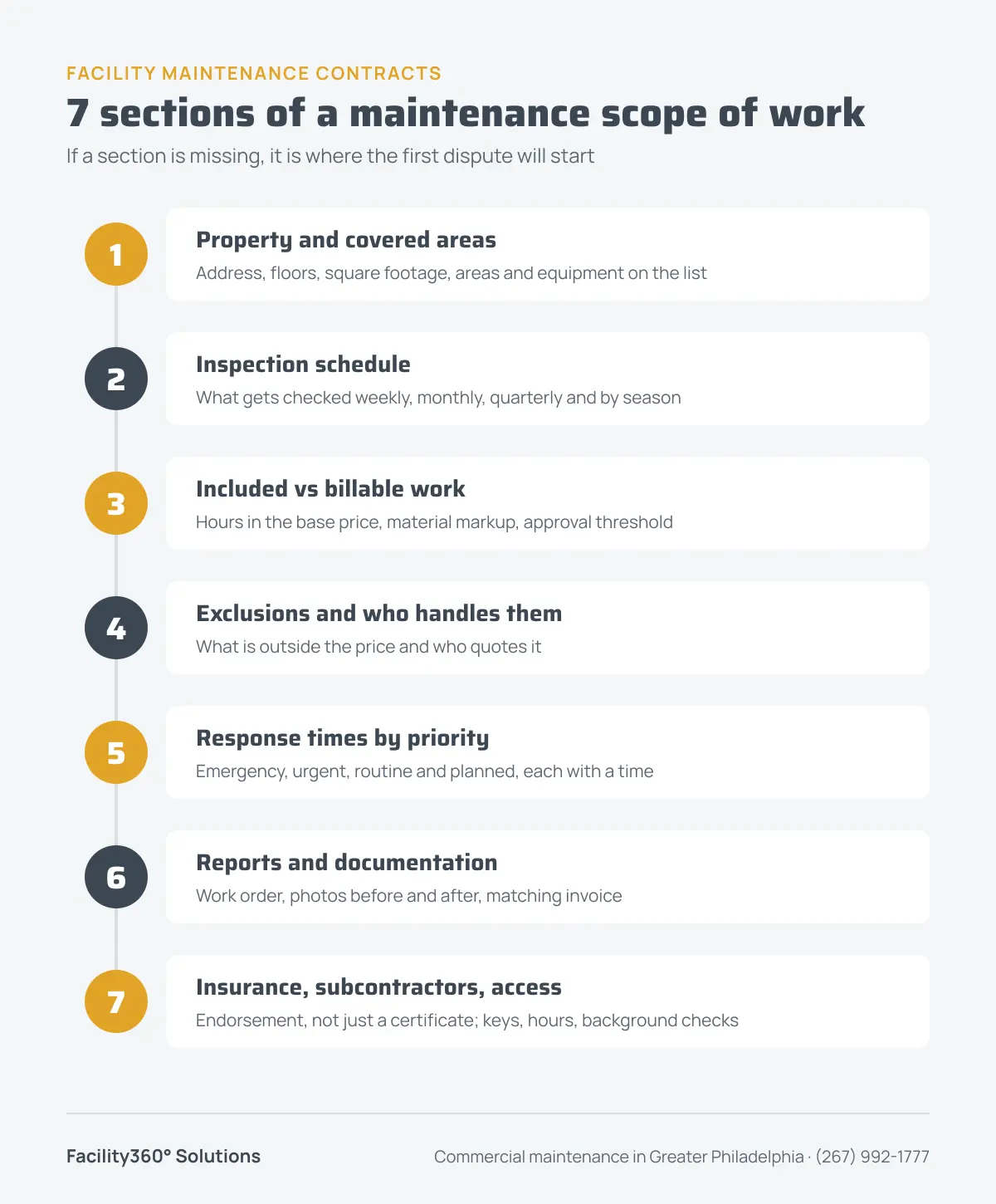
A commercial facility maintenance scope of work is the document that says what a maintenance contractor will do in your building, how often, for what price and how fast. A useful one covers seven things: the property and areas covered, the inspection schedule, which repairs are included and which are billed separately, what is excluded and who handles it, response times by priority, how work is documented, and insurance and site access terms.
Most disputes between property managers and maintenance contractors are not about bad work. They start when a repair comes up that neither side thought about when the agreement was signed, and both sides read the same two pages differently. A clear scope of work closes that gap before the first invoice.
This guide walks through each of the seven sections, gives you a one-page example you can adapt, and lists the red flags to catch when you compare proposals. It is written for property managers and building owners in Greater Philadelphia, and it applies to any contractor you are considering, including us.
A short, general scope looks cheaper on paper. A line like “general maintenance of common areas” fits on one page and gets a low monthly price. The cost shows up later, in three places.
The first is change orders. Every job that is not clearly in or out becomes a separate quote, an approval email and a delay. The second is missed work. If the scope never mentions roof drains or exit signs, nobody checks them until something fails. The third is time: your team ends up refereeing what is covered instead of running the building.
A detailed scope of work takes a few hours to put together. It saves that time within the first quarter of the contract.
Start with the basics, written so that someone who has never seen the building could understand what is covered:
The equipment list matters more than it looks. ASHRAE Standard 180, the national standard for inspecting and maintaining HVAC systems in commercial buildings, starts with an inventory of the equipment to be maintained, and everything else is built on that list. The same logic works for the whole building: if an item is not on the list, nobody is responsible for checking it.
Write down what gets checked and how often. A schedule that says “monthly walkthrough” is not enough. A good one names the items:
The scope should also say what you get after each visit: a written report, photos of problems found, and a list of items that need a decision from you. For a full list of tasks by month, quarter and season, see our annual maintenance checklist for office buildings. Winter adds its own items, which we cover in how to prevent frozen pipes in commercial buildings.
This is the section most disputes come from. The scope should answer three questions in plain numbers.
What is included in the base price? Often it is labor for small repairs found during scheduled visits, up to a set number of hours per month, with materials billed at cost or at cost plus an agreed markup.
What is billed separately? Usually larger repairs, after-hours emergency calls, tenant-requested work and anything that needs a specialist or special equipment.
What needs your approval before work starts? Set a dollar threshold. Below it, the contractor fixes and reports. Above it, you get a written scope and price first.
| Included in the base price | Billed separately | Needs your approval first |
|---|---|---|
| Scheduled visits and inspections | After-hours emergency calls | Any job above the agreed dollar threshold |
| Small repairs found on a visit, up to the agreed hours | Larger repairs and replacements | Work in tenant suites |
| Written report with photos after each visit | Materials and parts, at cost or cost plus markup | Anything that needs a specialist or special equipment |
| Closer, latch and fixture adjustments | Tenant-requested work | Work that requires a shutdown of water or power |
Example only. Agree the hours, markup and threshold in your own scope.
Every scope has limits, and a good one names them instead of leaving them to be discovered. Typical items outside a routine maintenance price are replacement of major equipment, roof replacement, janitorial service, landscaping and snow removal, and work on systems that have their own service contracts, such as elevators or fire alarm monitoring.
The important part is what happens next. For each exclusion, the scope should say whether the same contractor can quote and do the work, or whether you need another vendor. At Facility360 we handle the work ourselves or bring in a vetted specialist for the specific task and coordinate the job, so the building still has one point of contact. Either way, the excluded item is quoted separately and approved by you before it starts.
“Prompt response” means nothing in a contract. Define three or four priority levels, give an example of each, and put a response time next to it.
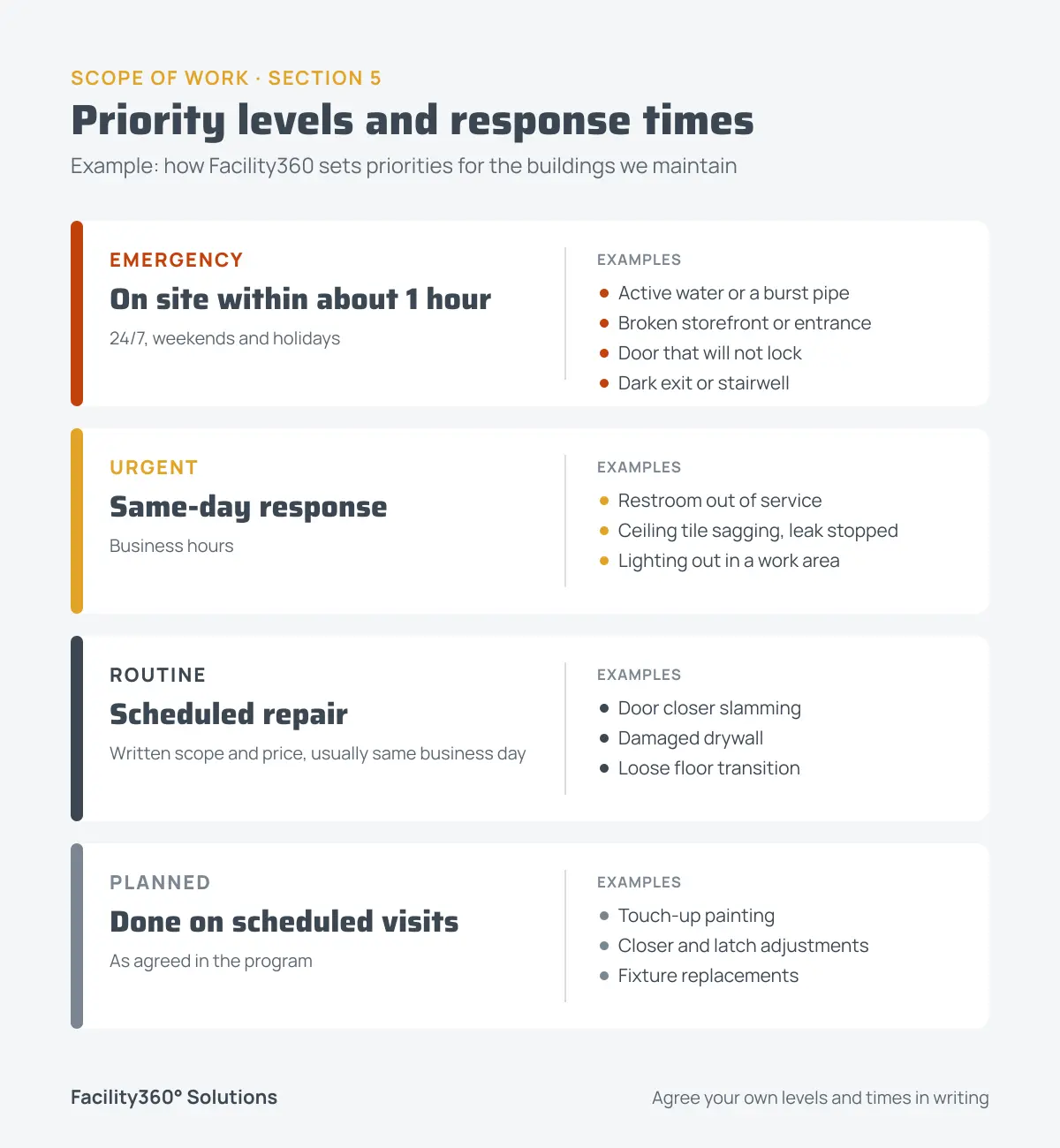
As an example, this is how we set priorities for buildings we maintain:
Whatever levels you agree on, the scope should also say who decides the priority of a call and how after-hours calls reach the contractor.
Good documentation protects both sides. The scope should require a work order for every job, photos before and after, a written note of what was found and what was done, and an invoice that matches the work order.
Ask for the same format on every call and every property. Over a year, those reports become the maintenance history of the building. They show which problems keep coming back, they support owner reports and budget requests, and after an emergency they give the insurance adjuster what the claim needs.
Ask for a certificate of insurance before work starts, and check what it actually proves. A certificate on its own does not make you an additional insured on the contractor’s liability policy. That status comes from an endorsement to the policy, so the scope should require the endorsement itself, not only the certificate. Many property managers also require the contractor’s coverage to be primary and non-contributory, so the contractor’s insurer pays first without seeking contribution from yours. A note on wording like this is worth running past your insurance broker.
Two more items belong in this section. If the contractor uses subcontractors, the same insurance requirements should apply to them, and you should know who is working in your building. And site access needs its own paragraph: who holds keys and alarm codes, which hours work is allowed, how tenants are notified, and whether technicians pass background checks.
Here is a short example for a three-story office building. Adjust the numbers and areas to your property.
Scope of Work: Routine Maintenance, 120 Example Street, Philadelphia
Property. Three-story office building, about 45,000 sq ft. Covered: lobby, common corridors, six restrooms, two stairwells, entrances, parking lot lighting, mechanical rooms. Tenant suites: quoted separately on request.
Inspections. Biweekly visits. Every visit: entrances, restrooms, common-area lighting, visible leaks. Monthly: door closers and locks, exit signs and emergency lights, ceiling tiles. Quarterly: roof drains, exterior lighting, caulking, dock door. Written report with photos within one business day of each visit.
Included repairs. Up to 6 labor hours per month for repairs found on visits. Materials at cost plus 10%. Jobs above $500 need written approval.
Billed separately. Emergency calls outside visits, larger repairs, tenant requests.
Exclusions. Elevator service, fire alarm monitoring, janitorial, landscaping and snow removal, roof and major equipment replacement. Contractor may quote these separately.
Response times. Emergency: 24/7, on site within about one hour. Urgent: same day. Routine: scheduled, with a written scope and price.
Insurance and access. Additional insured endorsement on the contractor’s liability policy, primary and non-contributory. Same requirements for subcontractors. Keys held by building engineer; work in occupied areas 7 am to 6 pm unless agreed; background-checked technicians.
Term and review. 12 months, review of scope and pricing after 90 days.
The same scope can be priced three ways, and the right one depends on how predictable the building is.
A fixed monthly fee works when the scope is clear and the building is stable. You know the cost in advance, and the contractor carries the risk of a busy month. Watch for a fixed fee paired with a vague scope: it usually means the contractor will bill everything that is not explicitly listed.
Time and materials works for older buildings or the first months with a new contractor, when nobody knows yet how much work the building generates. You pay for actual hours and parts, so ask for hourly rates, minimum charges and material markup in writing.
A hybrid is the most common in practice: a fixed fee for scheduled visits and inspections, plus time and materials for repairs above an agreed threshold. It keeps the base cost predictable without forcing the contractor to price in every possible repair.
The easiest way to compare contractors fairly is to send all of them the same scope of work and ask them to price against it. Differences in price then reflect differences in the work, not in how each proposal was written.
For buildings on our Facility Support Services program, the scope starts with a walkthrough. We look at the building with you, note recurring problems and agree on what the program should cover. You then get a written plan: visit frequency, what is checked on each visit, how repairs are approved and priced, and response times for emergencies. Management companies with several properties get one format for every building; see how we work with property managers.
If you only need repairs from time to time, our commercial handyman service works job by job, and emergencies go to our 24/7 emergency team.