

An office building maintenance checklist splits the upkeep of a building by frequency. Monthly tasks catch the things tenants notice first: lighting, doors, restrooms, leaks. Quarterly tasks cover the parts nobody looks at until they fail, such as roof drains, exterior caulking and dock doors. Seasonal tasks prepare the building for Philadelphia winters and humid summers. Annual tasks are the big inspections and the tests some equipment must pass every year.
Below is the full checklist we use as a starting point for the office buildings we maintain in Greater Philadelphia, organized by frequency, with notes on who usually does each item. It works for most commercial buildings, and the last section covers what to add for retail, medical offices and schools. There is also a printable version you can download and fill in.
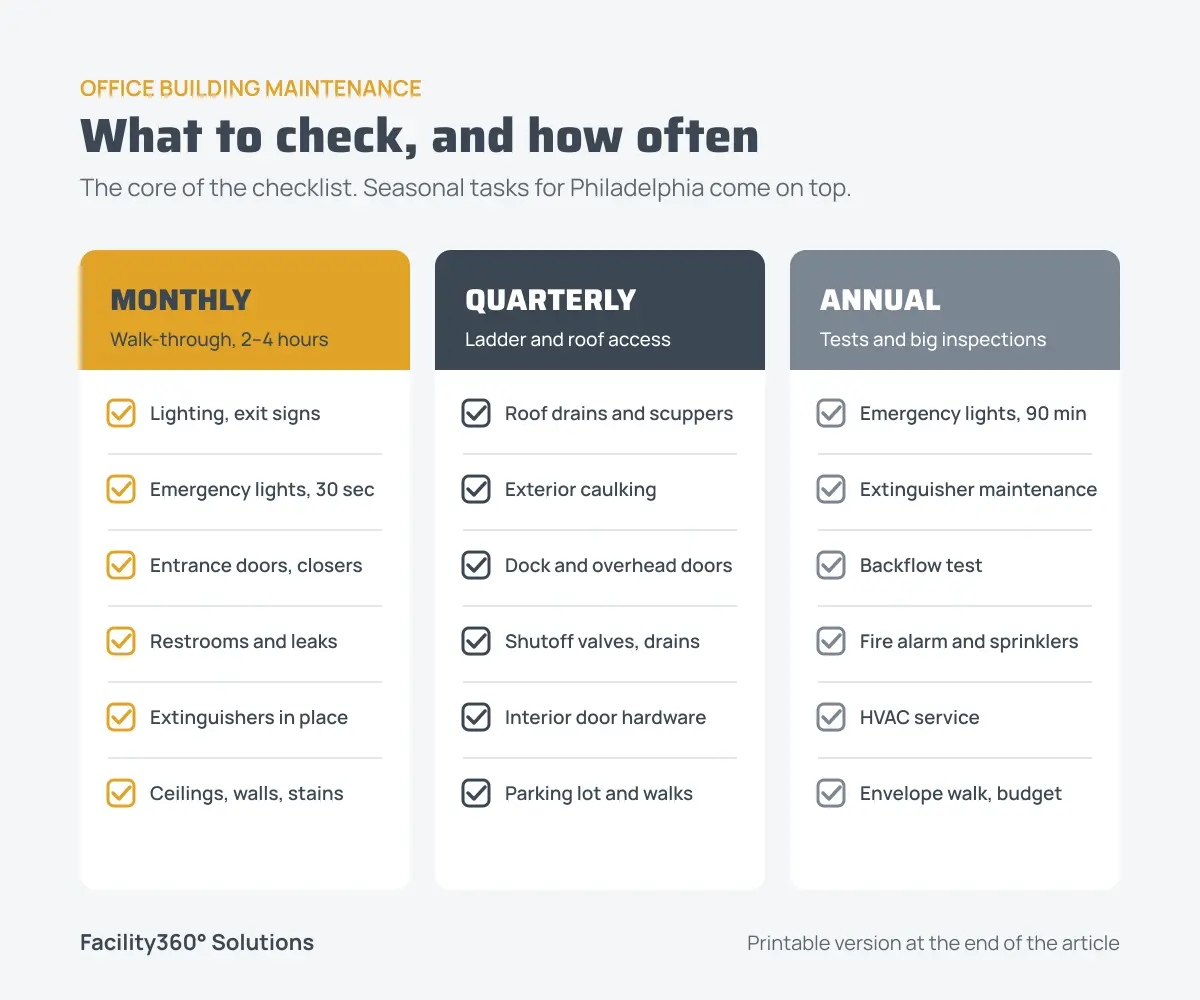
No building needs every line. A two-story office with one rooftop unit and a parking lot has a different list than a six-story building with a loading dock and a garage. Go through each table, remove what doesn’t apply, add equipment that is specific to your building, and assign every task an owner: your building engineer, your maintenance contractor or a certified testing company.
Three rules make the checklist work in practice:
These are walk-through items. In a building of average size they take two to four hours, and most of them can be combined with a regular maintenance visit.
| Area | What to check | Usually done by |
|---|---|---|
| Lobby and common areas | Lights out, damaged ceiling tiles, wall damage, trip hazards at flooring transitions | Maintenance contractor |
| Entrance doors | Closers, locks, panic hardware, door sweeps; doors close and latch on their own | Maintenance contractor |
| Restrooms | Leaks under sinks, running toilets, loose fixtures, partitions, dispensers | Maintenance contractor |
| Emergency lights and exit signs | 30-second test of battery units; every exit sign lit | Maintenance contractor |
| Fire extinguishers | In place, unobstructed, gauge in the green, tag current | Building staff or contractor |
| Stairwells and exits | Clear of storage, lights working, fire doors close and latch | Maintenance contractor |
| Ceilings and walls | New water stains, sagging tiles, cracks | Maintenance contractor |
| HVAC filters | Check and replace on the schedule for your equipment | Maintenance contractor |
| Exterior | Lighting, walkways, railings, trash areas, signs of pests | Maintenance contractor |
Quarterly items need a ladder, a roof hatch or a closer look than a walk-through allows.
| Area | What to check | Usually done by |
|---|---|---|
| Roof drains and scuppers | Clear debris, check strainers | Maintenance contractor |
| Exterior caulking and sealants | Windows, expansion joints, penetrations | Maintenance contractor |
| Loading dock and overhead doors | Springs, tracks, seals, bumpers, dock plate | Maintenance contractor |
| Plumbing | Shutoff valves operate, water heater area dry, floor drains have water in the trap | Maintenance contractor |
| Interior doors and hardware | Hinges, closers, latches, door stops in corridors and suites | Maintenance contractor |
| Parking lot and sidewalks | Potholes, cracks, faded striping, damaged wheel stops | Maintenance contractor |
| Electrical (visual) | Panel rooms clear and accessible, no scorched covers or exposed wiring | Maintenance contractor |
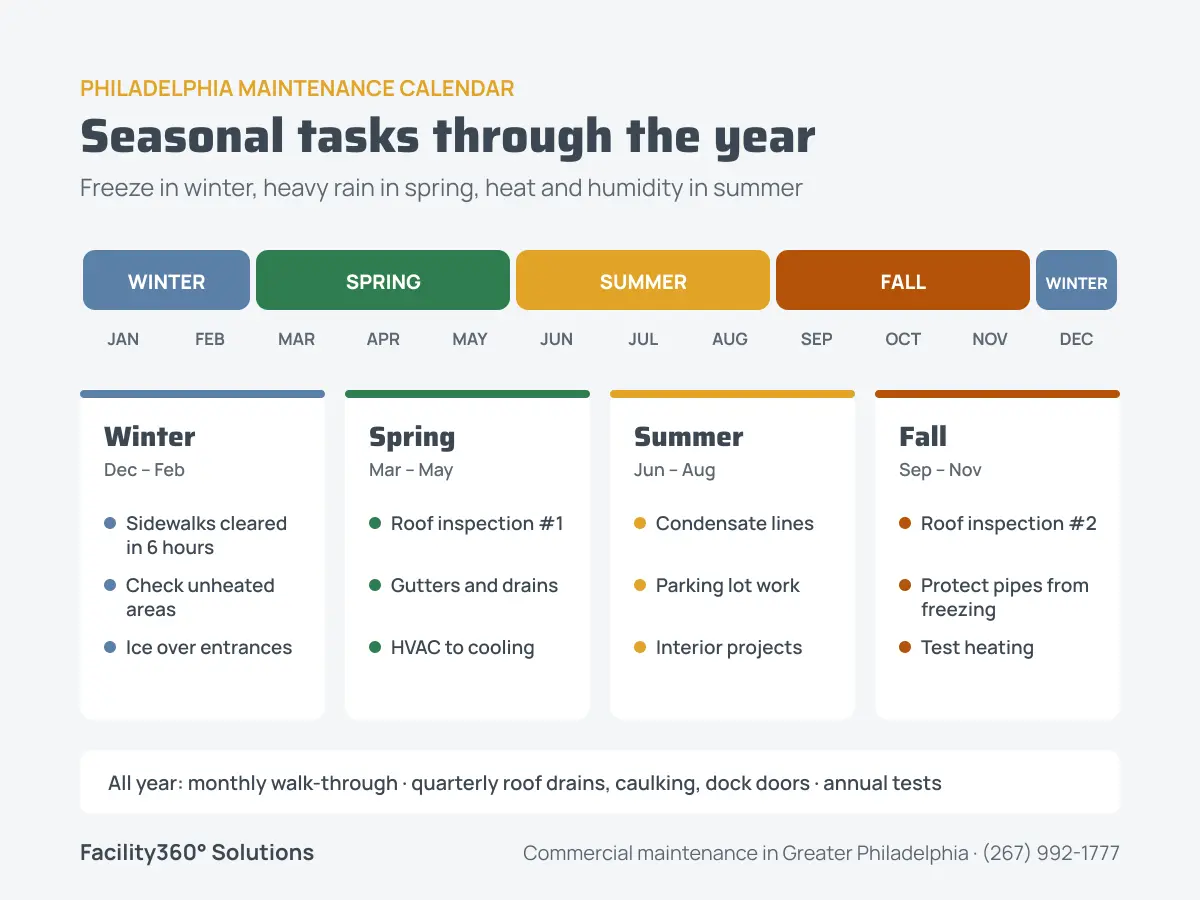
Philadelphia gets hard freezes in January and February, heavy spring rain, and hot, humid summers. Each season stresses a different part of the building, so seasonal tasks are tied to the calendar rather than to a fixed interval.
Some annual items are good practice. Others are required, and the interval is set by a code or a city regulation. These are marked in the table.
| Item | What it involves | Usually done by |
|---|---|---|
| Emergency lighting 90-minute test | Required: each battery unit runs 90 minutes on battery | Maintenance contractor |
| Fire extinguisher maintenance | Required: annual maintenance and new tag | Certified extinguisher service |
| Backflow prevention test | Required in Philadelphia: annual test by a city-certified tester | Certified backflow tester |
| Fire alarm and sprinkler testing | Required: on the schedule set by code and your fire protection company | Fire protection company |
| HVAC service | Full service per manufacturer and ASHRAE 180 practice | HVAC specialist |
| Building envelope walk | Facade, windows, roof, foundation; photos for the record | Maintenance contractor |
| Life-cycle review | Equipment age, repeat repairs, next year’s capital and repair budget | Owner, manager, contractor |
Items that require a certified tester, such as the annual backflow test, fire extinguisher maintenance and fire alarm testing, are done by the companies that hold those certifications. Your maintenance contractor can schedule them, give access and fix anything the test turns up, so the dates don’t slip.
The office checklist covers most of what any commercial building needs. A few building types add their own items.
Storefront doors and glass take daily abuse: check closers, pivots, locks and weatherstripping monthly. Add signage lighting, parking lot lighting and cart corrals to the monthly walk. For restaurants, add grease interceptors and kitchen exhaust cleaning on the schedule your local rules and vendor require.
Add a monthly check of exam room fixtures, sinks and hand-washing stations, and plan work around patient hours. Wall and floor finishes need to stay intact and cleanable, so damaged drywall, cove base and flooring move up in priority.
Most work happens during breaks. Use summer for painting, flooring and larger repairs, and do a full door and hardware check before students return. Bleachers, playground surfaces and gym equipment need their own inspection list.
A completed checklist is useful twice: when a tenant or an insurer asks about the condition of the building, and when you plan next year’s budget. Keep each year’s checklists together with the work orders they generated. After a year or two, the record shows which items keep coming back and are worth replacing instead of repairing again.
If you have a maintenance contractor, ask for a written report after every visit, with photos of problems found and work done. That report is your checklist record. Our facility support services include that report after every scheduled visit.
Download the printable checklist
Two pages with every monthly, quarterly, seasonal and annual item from this article, with columns for the date and initials. Print it or fill it in on screen.