

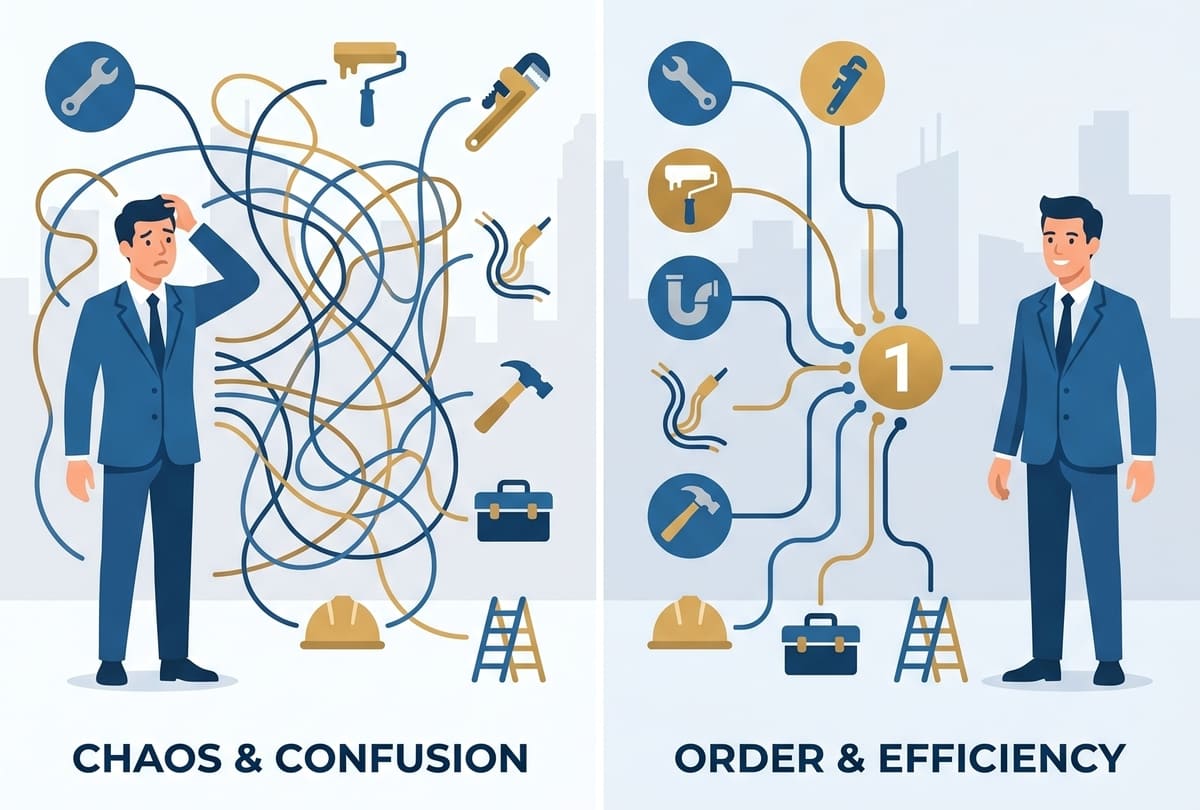
When a commercial property relies on a patchwork of separate contractors to keep the building running, the true expense rarely shows up on a single invoice. It hides in coordination hours, slow response times, inconsistent workmanship, and budget volatility that no spreadsheet line item ever captures. At Facility360°, we work with property managers and building owners across Greater Philadelphia who have lived this reality, and we have seen firsthand how consolidating maintenance under a single-source facility partner transforms both the numbers and the day-to-day experience of running a property. This article breaks down the genuine, often-overlooked cost of vendor sprawl and demonstrates why a unified approach is the smarter operational and financial decision for commercial real estate.
Vendor sprawl describes the gradual accumulation of separate service providers, each handling one narrow slice of a building’s maintenance needs. A typical sprawled setup might involve a handyman service for general repairs, an electrician for lighting and outlets, a drywall specialist, a door-hardware vendor, a painting contractor for tenant turnovers, an HVAC company, a plumber, and a separate emergency-response service. On paper, hiring a specialist for each task feels prudent. In practice, eight separate contractors means eight communication channels, eight billing cycles, eight sets of insurance documents, and eight different quality standards that rarely align.
This fragmentation does not announce itself as a problem. It creeps in. A new vendor is added to solve an immediate issue, another to cover a gap, and within a few years the property manager is no longer managing a building, but managing a sprawling roster of contractors who do not communicate with one another. Each addition feels reasonable in isolation. The cumulative weight is what breaks the system.
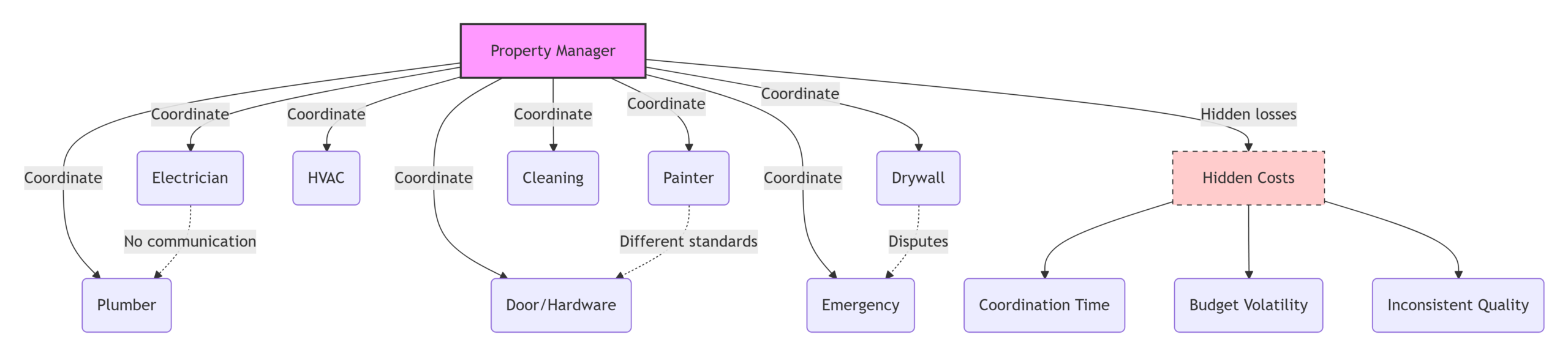
The most damaging expenses of vendor sprawl are invisible precisely because they are not billed. They surface as wasted time, lost productivity, and eroded tenant goodwill.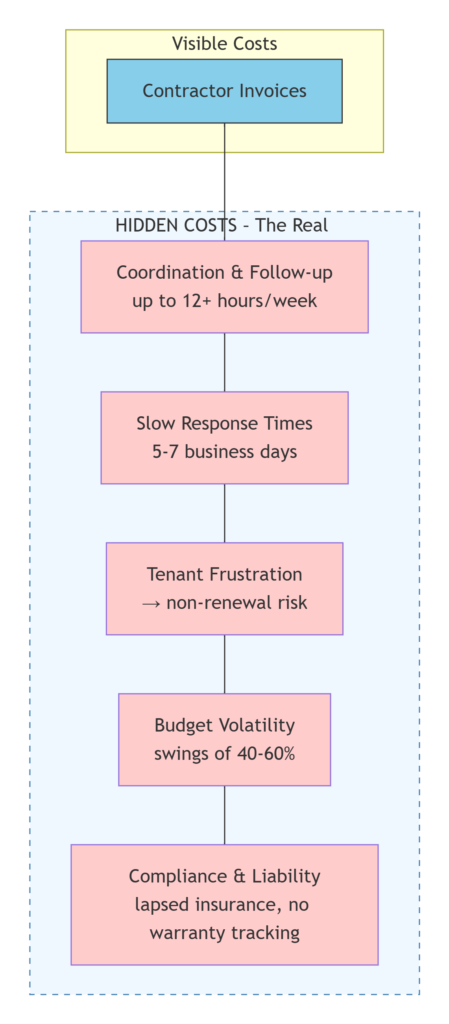
Every contractor a property manager juggles demands attention. Scheduling, follow-up calls, clarifying scope, chasing late work, and reconciling separate invoices consume hours that should be spent on tenant relations and strategic planning. In one multi-tenant office property we assessed, the manager was spending an estimated twelve hours per week simply coordinating contractors. That is roughly a day and a half of skilled labor every week, devoted not to improving the property but to herding vendors. Multiply that across a year and the opportunity cost becomes staggering.
When responsibility is split across many providers, no single party owns the outcome. A tenant reports a leaking fixture, the manager identifies which plumber to call, waits for availability, and then waits again for the work. In sprawled environments, average response times to maintenance requests can stretch to five to seven business days. For commercial tenants paying premium rents, slow maintenance is a direct threat to satisfaction, and tenant satisfaction is a direct threat to lease renewals. In commercial real estate, a single non-renewal can represent hundreds of thousands of dollars in lost annual revenue.
With multiple contractors, quality becomes a lottery. One vendor delivers excellent work; another cuts corners. When something goes wrong, the blame bounces between providers, and the property manager is left mediating disputes instead of receiving solutions. There is no single throat to choke, and no single party invested in the long-term condition of the building.
Perhaps the most corrosive cost is the loss of financial predictability. When monthly maintenance spending swings by forty to sixty percent with no discernible pattern, accurate budgeting becomes impossible. Reactive emergency calls, which are frequently preventable with proper inspection, spike the budget without warning and undermine every forecast.
Vendor sprawl also creates risk that rarely surfaces until something goes wrong. Each contractor carries separate insurance, separate licensing, and separate documentation, and verifying that every certificate is current across eight vendors is a job in itself. When a provider’s coverage lapses unnoticed, the property owner inherits the liability. Warranty tracking suffers too: with work spread across many hands, there is often no consolidated record of what was done, when, by whom, or under what guarantee. A single accountable partner maintains unified documentation, current insurance, and a complete service history, closing gaps that fragmented vendor rosters routinely leave open.
A single-source facility maintenance model replaces this chaos with coherence. Instead of orchestrating a dozen relationships, the property manager works with one accountable partner who handles general repairs, minor plumbing and electrical, drywall and ceiling work, painting and touch-ups, door and hardware service, and preventive maintenance, all under one roof. This is the foundation of our Facility Support Services program.
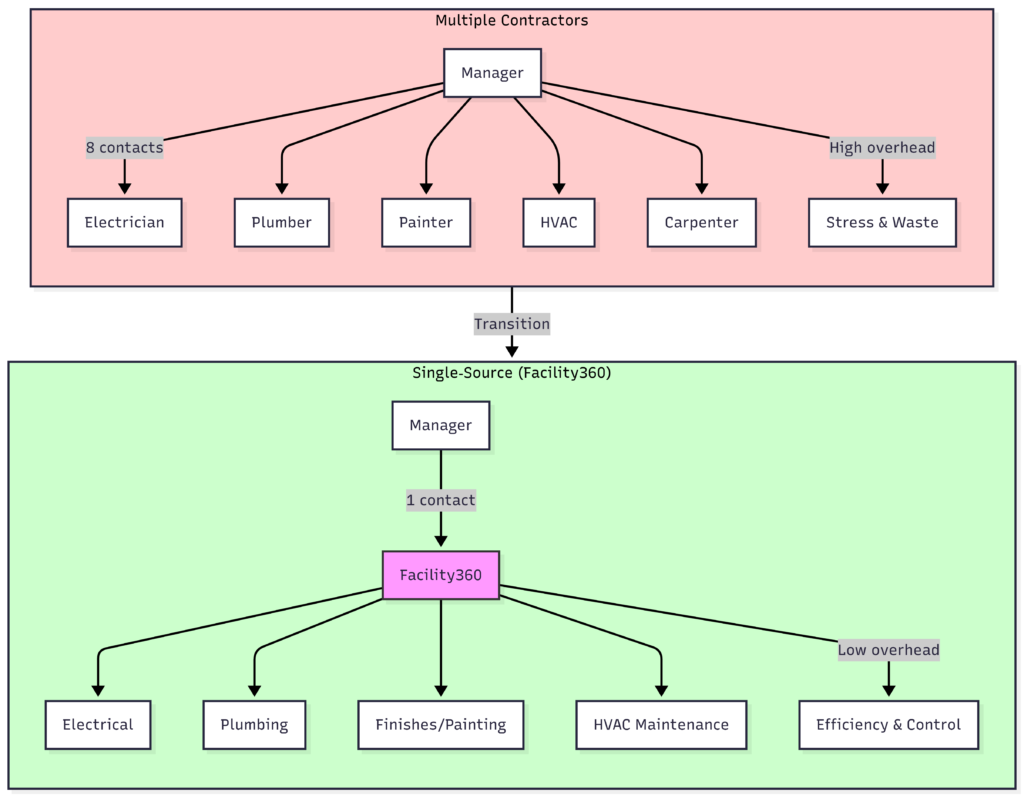
A single dedicated account manager fields every request, eliminating the scheduling maze and the endless follow-up calls. Communication becomes simple, fast, and traceable. When a tenant reports an issue, one call sets the response in motion, and one person owns it through to completion.
One vendor means one invoice, one billing cycle, and one consolidated monthly report documenting completed work, upcoming tasks, and transparent budget tracking. Financial clarity replaces guesswork, and forecasting becomes a matter of reading a trend rather than bracing for the next surprise.
When the same team maintains a property over time, they learn its systems, its quirks, and its history. That institutional knowledge produces consistent, commercial-grade workmanship and a vested interest in the building’s long-term health, something no rotating cast of contractors can provide.
A unified partner can prioritize urgent requests and build a preventive maintenance schedule that catches small issues before they become expensive emergencies. Scheduled inspections replace reactive panic, and the building’s condition steadily improves rather than degrades. Over time, the shift from reactive to preventive is where the largest savings accumulate.
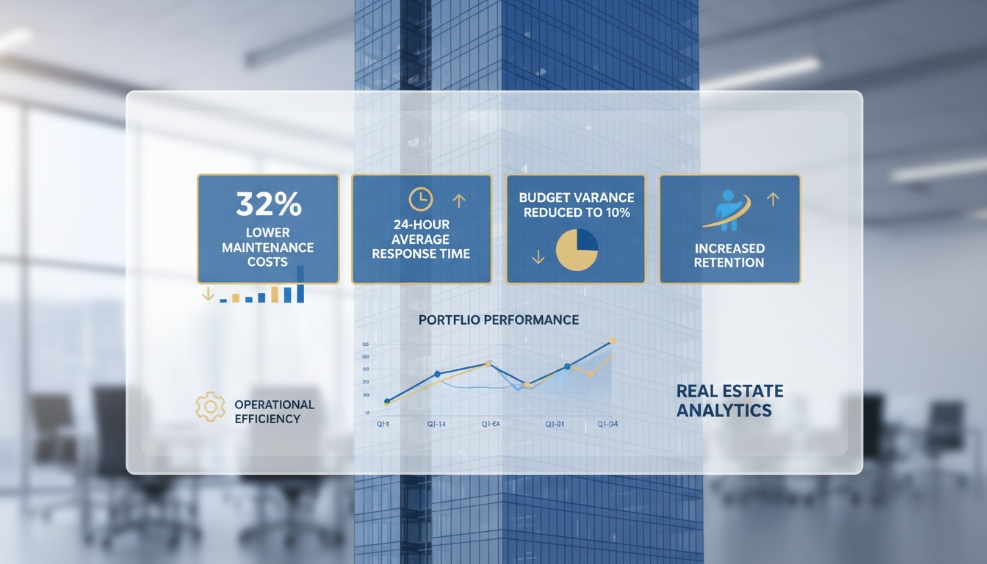
The case for single-source facility management is not theoretical. When property managers consolidate, the results are concrete and repeatable. In a recent facility support program for a 35,000 sq ft Conshohocken office building, replacing a roster of eight contractors with one accountable partner produced a thirty-two percent reduction in total maintenance costs year over year, a sharp drop in preventable emergency calls, response times falling from days to under twenty-four hours, and budget variation shrinking from roughly sixty percent to under ten percent. Crucially, these operational gains translated into stronger tenant retention, the single most important driver of commercial property value.
Consolidation is not a universal rule, and an honest assessment matters more than a sales pitch. Highly specialized systems, such as elevators, fire-suppression equipment, and certain proprietary HVAC platforms, often require manufacturer-certified technicians under dedicated service contracts, and those relationships should usually remain in place. A single-source partner does not replace every specialist; it absorbs the broad base of recurring, general, and preventive work that does not require niche certification, and then coordinates with the handful of true specialists a building genuinely needs. The goal is not one vendor at any cost, but the right number of accountable relationships, with one partner owning the majority and the coordination. For most commercial properties, that means consolidating six or eight general providers into one, while retaining one or two certified specialists.

The prospect of switching maintenance models can feel daunting, but a well-run transition is methodical and low-risk. It begins with a property assessment: a complete walkthrough documenting the condition of building systems, outstanding deferred maintenance, and an inventory of assets. From that baseline, a custom service plan is built around the property’s size, tenant mix, and operational rhythm. Vendor consolidation follows, with the new partner absorbing general services while genuinely specialized contracts are reviewed and retained where appropriate. Throughout, work continues on schedule with minimal tenant disruption, and a single point of contact replaces the scattered roster from day one. The result is not a disruptive overhaul but a steady handover, and most property managers find the new model pays for itself within months through cost savings alone.
We built Facility360° specifically for the commercial market, serving property managers and building owners across Montgomery, Chester, Delaware, Bucks, and Philadelphia counties. Our model is designed to eliminate vendor sprawl entirely, replacing fragmented contractor rosters with a single, reliable partner that streamlines operations, reduces response times, and ensures consistent quality across every property we touch. From commercial handyman services and drywall and ceiling patching to lighting and outlet replacement and tenant turnover repaint services, every capability lives under one accountable program.
The real cost of vendor sprawl is not just the money spent, but the time lost, the tenants frustrated, and the opportunities missed. Consolidating to a single-source partner is not merely a convenience; it is a strategic decision that protects your budget, your tenants, and the long-term value of your property.