Commercial painting for government, healthcare, brewery, apartment, and historic mixed-use properties across the county seat.
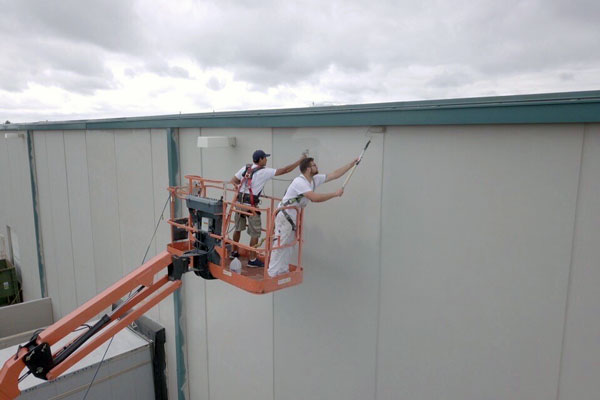
Norristown is the Montgomery County seat and one of the most operationally diverse commercial environments in the region — a Home Rule municipality of roughly 35,700 residents inside ZIP 19401, anchored by the Montgomery County Courthouse and the Norristown Transportation Center SEPTA hub.
The downtown is undergoing active revitalization through LERTA tax abatement, the Keystone Enterprise Zone, and the Historic Facade Grant Program. Commercial painting projects here come from a wider range of property types than most suburban markets: government and judicial facilities, healthcare and social-services tenants, the brewery and entertainment cluster along DeKalb Street, apartment-complex redevelopment along the Schuylkill River, mixed-use buildings on Main Street and Markley, and Victorian and Art Deco historic stock.
Each property type carries different scheduling, documentation, and paint specification requirements. A generalist contractor sized for one of them isn’t sized for the others.
Facility360° Solutions is a licensed Pennsylvania commercial contractor delivering commercial painting across this corridor. Project-based scoping with a written timeline before the work begins, paint and finish specifications matched to each property type, scheduling discipline around government hours, patient operations, brewery service windows, and apartment turnover dates, and documentation formatted to fit each facility’s record-keeping standard.
Our scope covers the full painting envelope and the substrate prep that determines whether a finished paint job actually holds up:
Every project starts with an on-site assessment — substrate condition (plaster, drywall, or combination in older downtown stock), paint and finish recommendation matched to tenant type and operational reality, color matching against existing finishes where applicable, and a written project quote with realistic timeline.
Commercial painting projects across this property mix run on different operational rhythms than a single-tenant-type market. Each property type carries its own scheduling reality, documentation standard, and finish requirement.
Facilities along the courthouse corridor operate under public-sector procurement workflows where vendor approval, insurance documentation, and post-project reporting have to fit the facility’s internal record-keeping standard.
After-hours and weekend scheduling typically fits public-facing areas, with documentation formatted for the agency’s procurement and facility record systems.
Medical offices, outpatient clinics, and behavioral-health facilities require low-VOC and antimicrobial paint systems where indoor air quality is regulated. Work runs in phased zones around patient operations, with isolation barriers around active-care areas.
For higher-disruption scope, after-hours and weekend windows typically accommodate the project without shutting the practice down.
The brewery and restaurant cluster along DeKalb — including operators like Von C Brewing and El Jefe — runs taproom and dining-area interiors that need to fit operational service schedules. Brand colors for accent walls and feature work are matched against the operator’s brand standard before commitment.
Production-support areas and back-of-house surfaces requiring chemical-resistant finishes are scoped as durable-coating environments rather than standard interior paint.
Apartment-complex redevelopment along the Schuylkill River corridor — including projects like The Luxor Lifestyle complex — runs on tenant turnover cycles where unit repaint speed directly affects days-to-rerent.
Multi-unit turnover projects sequence crews so units come back online in coordination with the rerent calendar rather than waiting on general crew availability.
The Historic Facade Grant Program provides matching funds for facade restoration work in eligible downtown commercial properties. Facade repaint scope inside the program is documented in a format the grant application requires, and material selection accounts for the streetscape character along Main Street, DeKalb, and Markley.
For property owners using the grant program, timing facade work to the grant cycle is part of the project planning rather than an afterthought.
Victorian and Art Deco downtown buildings carry original plaster walls behind decorative trim. Plaster requires substrate-compatible primer, surface failure addressed before topcoat, and an application technique that doesn’t pull additional material loose.
A commercial paint job is only as good as the substrate prep underneath, the product spec selected for the environment, and the documentation that goes back to the property team afterward.
Nearby areas: East Norriton · West Norriton · Plymouth Township · Bridgeport · Jeffersonville · Eagleville · Audubon · Trooper
Also serving: Plymouth Meeting · King of Prussia · Conshohocken · Philadelphia
✓ Commercial-Grade Paints & Methods
✓ Government, Healthcare & Brewery Experience
✓ Property-Type-Specific Documentation
✓ Historic Facade Grant Program Awareness
OUR PAINTING WORK IN NORRISTOWN
Older Norristown buildings rarely take paint straight — settled plaster, previous coats and aged trim all need addressing before a roller touches the wall. See how we prepped, patched and repainted a community facility interior, working section by section so the building stayed open the entire time. Review the scope, the work performed and the outcome.
Commercial-Grade Painting. Scheduled Around Your Operations. Finished Right.
When a paint project needs to fit a government procurement workflow, healthcare patient hours, a brewery service window, or an apartment turnover date — one call schedules an on-site assessment with a written quote.
Yes. We carry insurance, licensing, and credential documentation ready for facility-manager review, work through each agency's procurement workflow, and structure post-project reporting to fit internal record-keeping. For ongoing relationships, approvals and access protocols are pre-loaded so subsequent projects start cleanly.
A standard apartment-unit repaint fits a 1–2 day window depending on unit size, ceiling work, and trim detail. Multi-unit turnover projects sequence against actual move-in dates rather than against general availability, so units come back online in coordination with the rerent schedule.
Yes. We document facade scope, material selection, and condition photography in a format the grant application requires, and time work to align with grant approval and disbursement. For property owners actively using the program, this is built into the project workflow rather than handled as a separate documentation effort.
For most outpatient and clinical-suite repaints, phased work using low-VOC and antimicrobial paint systems is achievable around patient hours. Common areas first, exam rooms in sequence keeping a workable subset operational, with isolation barriers around active-care zones. For higher-disruption scope, after-hours and weekend windows typically fit.
Yes, with scope separated by environment. The taproom and dining areas use standard commercial interior paint scheduled around service hours. The back-of-house, kitchen, and production-support areas use chemical-resistant durable coating systems scheduled during off-service windows. Documentation separates the two scopes for accurate billing and any future warranty reference.
Let’s keep your business facility one step ahead
One call schedules an on-site assessment with substrate evaluation, color matching where applicable, and a written project quote with realistic timeline. Covering government, healthcare, brewery, apartment, and mixed-use properties across the county seat.
Request Your Free Estimate
Request commercial service
Tell us what needs attention and we’ll get back to you with next steps.
Request commercial service
Tell us what needs attention and we’ll get back to you with next steps.