From the courthouse-adjacent government and healthcare corridor to Main Street and DeKalb Street mixed-use buildings, the apartment-complex redevelopment along the river, and the brewery and restaurant cluster downtown — Facility360° delivers a single-vendor facility support program built for the county seat's diverse commercial property landscape.
Norristown is the Montgomery County seat and one of the most operationally diverse commercial environments in the region — a Home Rule municipality of roughly 35,700 residents inside ZIP 19401, anchored by the Montgomery County Courthouse, the Norristown Transportation Center SEPTA hub, and a downtown undergoing active revitalization through LERTA tax abatement, the Keystone Enterprise Zone, and the Historic Facade Grant Program. The commercial property mix here doesn’t fit a single category. Property managers and owners along this corridor run portfolios that span government and judicial facilities, healthcare and social-services buildings, the brewery and entertainment cluster on DeKalb, mixed-use redevelopment projects like The Luxor Lifestyle complex, apartment communities along the river, and a stretch of small-business storefronts along Main Street. Each tenant type carries different access requirements, different documentation standards, different procurement workflows, and different operational rhythms. The default solution — managing six to eight contractor relationships per building type — burns the property team’s week on coordination and produces inconsistent documentation across what’s already a complex portfolio.
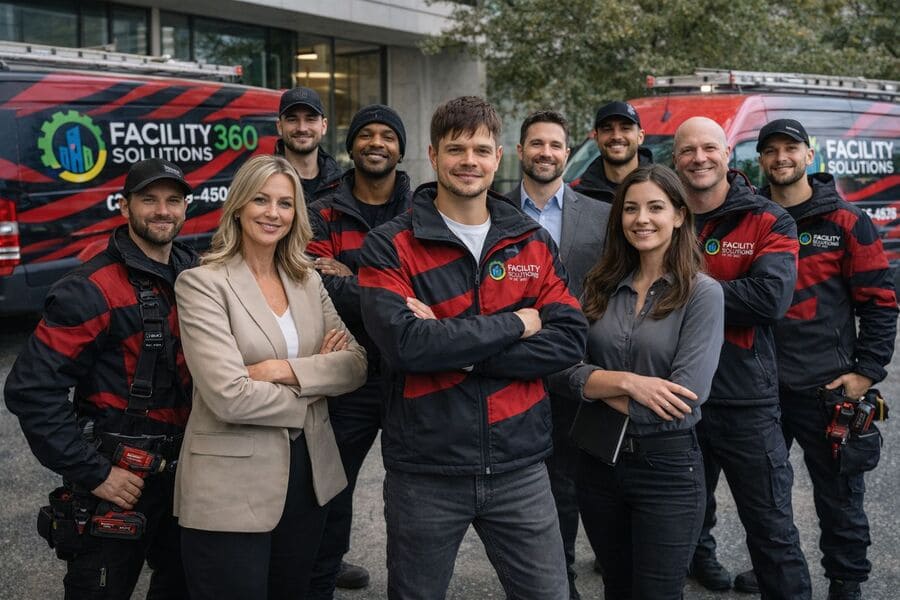
Facility360° Solutions is a licensed Pennsylvania commercial contractor that replaces that coordination overhead with a single facility support program. One account manager. One billing cycle. Scheduled service windows with written reporting after every visit. Same-day response for urgent issues, 24-hour response for standard requests, and proactive identification of problems before they escalate into emergency calls.
The facility support program is designed for property managers, municipal facility teams, and commercial owners who need a single, reliable partner across all routine and recurring maintenance:
Clients moving to an active facility support program typically see a 40–60% reduction in unplanned maintenance calls within the first year, a meaningful drop in tenant complaints about repair quality, and a maintenance budget that becomes predictable enough to plan against rather than absorb as a variable cost.
What makes this corridor different from purely corporate or purely downtown commercial environments is the breadth of building types under active property management at any given time. Government and judicial facilities operate under specific procurement rules, vendor documentation requirements, and after-hours access protocols that are different from private commercial buildings. Healthcare and social-services tenants add infection-control awareness, patient-zone protocols, and compliance documentation that has to flow back into the facility’s internal record-keeping. Apartment communities — particularly the newer mixed-use redevelopment along the river — run on unit-turnover cycles where the time between move-out and move-in is the critical path for revenue recovery, and routine maintenance scope crosses common areas, leasable units, and the building envelope. Mixed-use buildings combining ground-floor retail or restaurant space with upper-floor residential add their own coordination layer between commercial tenants and residential occupancy. The downtown historic stock — Victorian commercial blocks and Art Deco buildings along Main Street, DeKalb Street, and Markley Street — adds older-construction maintenance realities on top of the property-type complexity. A facility support program in this environment has to handle each property type to its own standards while consolidating everything into a single coordination workflow.
Our crews work routinely across this kind of building mix — government and courthouse-adjacent properties, the brewery and restaurant cluster on DeKalb, the apartment-complex redevelopment along the river corridor, and the small-business storefronts of the downtown revitalization footprint. The assessment-first approach is the starting point for every new client: a complete property walkthrough documents existing condition, identifies deferred-maintenance items at the building level, builds an asset inventory across common areas and tenant suites, and produces a photographic baseline for future reference. For municipal and healthcare clients, the assessment also confirms the documentation format the facility’s internal record-keeping requires so the program output integrates cleanly from day one. The goal isn’t to run more service calls — it’s to run fewer, with each one planned, documented, and resolved on the first visit to the standards each property type actually requires.
Nearby areas: East Norriton · West Norriton · Plymouth Township · Bridgeport · Jeffersonville · Eagleville · Audubon · Trooper
Also serving: Plymouth Meeting · King of Prussia · Conshohocken · Philadelphia
✓ Single Point of Contact
✓ Government & Healthcare Experience
✓ Scheduled Service + Written Reporting
✓ Proactive, Not Just Reactive
OUR WORK IN NORRISTOWN
As the Montgomery County seat, Norristown carries a dense stock of historic civic and religious buildings — Victorian and Art Deco structures that need upkeep matched to their age. See how we maintain a local community facility with painting and repairs handled by one contractor. Review the scope, the work performed and the outcome.
One Partner. Every Repair. Total Facility Control.
Keep your commercial property maintained, professional, and fully operational — with one reliable team handling every repair, inspection, and maintenance task. From Main Street and DeKalb to the courthouse corridor and the river redevelopment, we cover it all.
Yes, and this is one of the operational pieces that determines whether a facility partner is actually viable for public-sector property. We carry the insurance, licensing, and credential documentation needed for municipal vendor approval, work through the procurement workflow each agency or department uses, and structure invoicing and reporting to fit the facility's internal record-keeping. For ongoing or contracted municipal relationships, we pre-load the access, approval, and documentation requirements into the work-order workflow so each visit starts from the correct procedure rather than rebuilding the protocol every time. The same approach applies to county-funded healthcare and social-services facilities operating under similar procurement frameworks.
Yes, and this is one of the clearest operational returns for multi-family property. Turnover speed depends on three things: how quickly the unit is assessed after move-out, how predictably the repair and repaint work scopes get scheduled, and whether the work crew shows up when they said they would. Under a facility support program, post-move-out walkthrough is part of the standard workflow, the scope is captured in a work order the same day, and turnover repaint plus repair work runs against a predictable schedule rather than waiting for contractor availability. For properties running steady-state turnover, the time saved across cycles aggregates significantly across a year.
Healthcare and social-services environments require access discipline that most generalist facility programs aren't built for. Routine work is scheduled into windows that don't disrupt patient or client hours, our crews follow the building's infection-control protocols and patient-zone boundaries, and work zones are isolated from active-care areas with appropriate barriers. Documentation is structured to support the facility's internal compliance reporting in parallel with the standard work-order record. For ongoing programs at healthcare and social-services facilities, the building's specific protocols are pre-loaded into the work-order workflow so each visit operates from the correct procedure rather than rebuilding it every time.
Yes. The Historic Facade Grant Program provides matching funds for facade restoration work in eligible downtown commercial properties, and timing maintenance and restoration work to the grant cycle is one of the operational decisions where a structured program helps. During scheduled inspections we identify facade and exterior items that may qualify for grant-funded restoration versus standard maintenance scope, document conditions in a format the grant application requires, and coordinate work timing so the restoration phase aligns with grant approval and disbursement. For property owners actively using the grant program, having this built into the routine maintenance workflow removes most of the documentation burden.
Yes, and this is one of the operational arguments for a single program over fragmented contractor relationships in a diverse portfolio. Each building type runs on its own service plan with the appropriate inspection cadence, scope, and documentation format — but the workflow, account manager, billing, and consolidated reporting are common across the portfolio. The property team sees one monthly view instead of reconciling reports from a brewery handyman, a healthcare facility contractor, a government-approved vendor, and an apartment-turnover crew. Each property type still gets handled to its own standards; the coordination burden is what gets consolidated.
Let’s keep your business facility one step ahead
One call schedules your free on-site assessment — a complete property walkthrough with a written program proposal. Covering government, healthcare, mixed-use, and apartment properties across the county seat.
Request Your Free Estimate
Request commercial service
Tell us what needs attention and we’ll get back to you with next steps.
Request commercial service
Tell us what needs attention and we’ll get back to you with next steps.