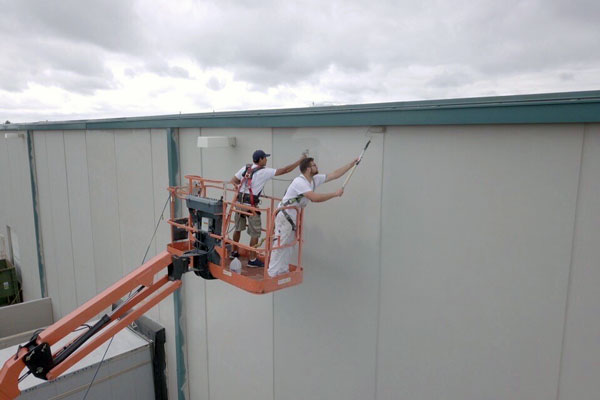
Industrial and warehouse painting is a fundamentally different discipline from commercial interior painting — and contractors who treat it as the same job produce results that fail within one to two seasons. Warehouse walls face forklift exhaust, chemical splash, pressure washing, condensation from loading dock temperature cycling, and physical impact from equipment and pallets. Standard interior latex applied to these conditions absorbs grease, fails adhesion under chemical contact, and shows physical damage within months of application. Facility360° Solutions provides industrial and warehouse painting services for production facilities, distribution centers, manufacturing plants, and storage warehouses across Greater Philadelphia — specifying high-build epoxy, alkyd enamel, and urethane coating systems for the actual exposure conditions of your facility, applying OSHA-compliant safety markings, and operating aerial lifts and airless spray equipment to complete large industrial scopes efficiently without disrupting your operations.
We carry commercial industrial coating systems from Sherwin-Williams Industrial, PPG Protective & Marine, and Benjamin Moore Industrial on every project — products specified for industrial chemical exposure, washability, and service life in demanding environments.
No two industrial facilities have identical exposure conditions — and no two sections of the same facility necessarily require the same coating system. A warehouse office wall, a loading dock wall, a production area wall with chemical splash exposure, and a cold storage wall with condensation cycling all require different primers, different coating systems, and different application protocols to achieve comparable service life. Quoting industrial painting without a site assessment produces one of two outcomes: a generic specification that underperforms in the most demanding areas, or an over-specified system applied uniformly where only portions of the facility require it. We conduct a systematic site assessment before specifying any industrial painting scope — identifying the exposure conditions of each area, documenting existing coating condition, and providing a zone-by-zone specification with the coating system and expected service life for each section. That assessment is what turns an industrial painting quote into an industrial painting solution.
Our industrial painting crew serves facilities throughout Greater Philadelphia — including Philadelphia, King of Prussia, Conshohocken, Bensalem, Horsham, and surrounding communities. We operate aerial lift equipment, airless spray systems, and carry commercial industrial coating inventories from Sherwin-Williams Industrial and PPG Protective & Marine — arriving prepared to work at the scale and specification that industrial facilities require.
Call now for a commercial industrial and warehouse painting assessment: (267) 992-1777 — or request a site visit online.
Others Services
Standard interior latex on a warehouse wall exposed to forklift exhaust and pressure washing lasts one season. The correct high-build epoxy or alkyd system, properly prepared and applied, lasts 7–10 years in the same environment. We specify and apply the system that matches your facility — not the cheapest product that fits the budget.
Industrial walls require coatings rated for the specific exposure — not standard interior latex. High-build alkyd enamel handles grease, oil, and general warehouse conditions. Two-component epoxy is specified for chemical splash, pressure washing, and food-adjacent areas. Urethane topcoat over epoxy adds UV resistance where natural light is present. Intumescent coatings are applied to structural steel where fire-resistance ratings are required by code. We assess each zone separately — a production floor wall and an office wall in the same building require different systems.
OSHA 29 CFR 1910.144 assigns: yellow for caution and aisle markings, red for fire equipment and danger zones, orange for machinery hazards, green for first aid and safety equipment, white and black for traffic flow and housekeeping boundaries. We apply all markings to OSHA color specifications using traffic-rated paint with colors documented in the project completion report.
Yes — through zone-by-zone phased scheduling coordinated with your shift supervisor. We paint one zone while adjacent areas operate, use low-odor water-based systems where solvent odor affects operations, and time cure windows around your production schedule. A zone-by-zone schedule is provided and confirmed before mobilization.
Steel surface preparation to SSPC standards first — wire brushing or grinding removes rust and mill scale. Zinc-rich or epoxy rust-inhibitive primer applied to bare steel. Alkyd, epoxy, or urethane topcoat over primer matched to the chemical and UV exposure of the area. We operate aerial lifts for ceiling-height structural steel — no scaffolding delays on standard warehouse heights.
Safety aisle markings and hazard zone colors typically degrade under forklift traffic and cleaning within 2–4 years — well before wall coatings fail. Faded or unreadable safety markings create OSHA compliance exposure regardless of wall condition. We recommend a safety marking inspection and refresh on a 2–3 year cycle, included in our Preventive Maintenance & Service Contracts.
From everyday maintenance and upgrades to emergency repairs, Facility360° Solutions helps you plan, budget, and execute the work your commercial property needs to stay safe, efficient, and looking its best — with minimal disruption to your operations.
Request commercial service
Tell us what needs attention and we’ll get back to you with next steps.
Request commercial service
Tell us what needs attention and we’ll get back to you with next steps.