
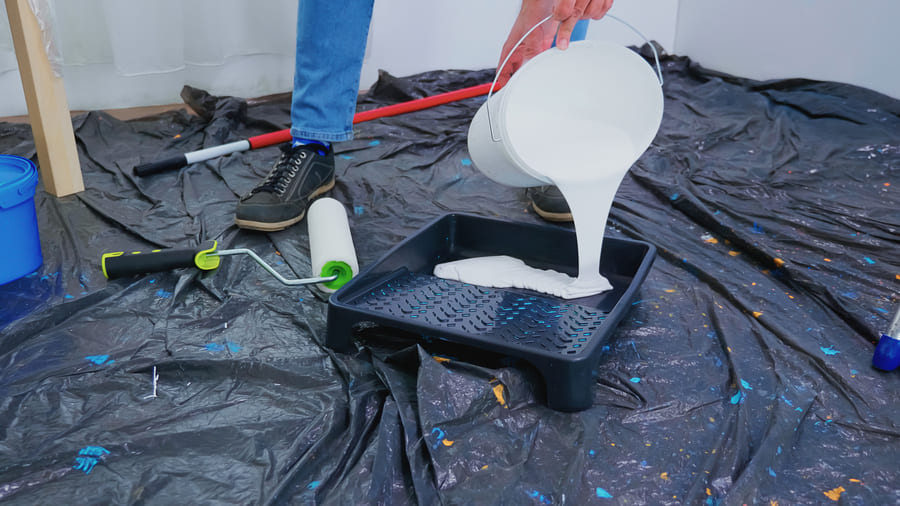
Low-VOC and durable coating systems are not a niche product category for environmentally conscious clients — they are the correct specification for a broad range of commercial painting applications where standard interior latex either creates health and odor issues during application or fails prematurely under commercial cleaning and traffic conditions. Medical facilities, schools, senior living centers, hotels, and high-traffic office corridors all have one thing in common: the walls are cleaned frequently, occupied continuously, and expected to maintain a professional appearance for years between repaints. Facility360° Solutions specifies and applies low-VOC and durable commercial coating systems for facilities across Greater Philadelphia — selecting the correct product for your occupancy type, surface exposure, and service life requirement, and applying it at the correct film thickness that actually delivers the performance the product is rated for.
We carry zero-VOC and low-VOC commercial coating systems from Sherwin-Williams Emerald, Benjamin Moore Scuff-X and Aura, and PPG Diamond — products with documented scrub resistance ratings, LEED-compliant VOC content, and the washability that commercial environments demand.
The practical distinction between low-VOC, zero-VOC, and standard commercial latex matters most during and immediately after application — and diminishes significantly after the paint film has fully cured. Standard commercial latex typically contains 150–250 g/L of VOCs, producing a strong chemical odor during application that persists for 24–48 hours in an enclosed commercial space. Low-VOC products at 50 g/L or less reduce that odor significantly — acceptable for most after-hours commercial painting where the space is vacant overnight. Zero-VOC products at 5 g/L or less produce minimal detectable odor during application — appropriate for occupied or immediately re-occupied spaces. The performance difference between low-VOC and standard paint is negligible in correctly specified commercial-grade products — modern waterborne technology delivers equivalent scrub resistance, adhesion, and durability to solvent-based systems when applied at the correct film thickness. The choice between low-VOC and zero-VOC is an occupancy and scheduling decision, not a performance compromise.
Our commercial painting crew serves facilities throughout Greater Philadelphia — including Philadelphia, King of Prussia, Conshohocken, Bensalem, Willow Grove, and Horsham. We carry zero-VOC and low-VOC commercial coating inventories on every project vehicle — arriving prepared to specify and apply the correct system for your occupancy type without product sourcing delays.
Call now for a low-VOC and durable coating specification consultation: (267) 992-1777 — or request a site assessment online.
Others Services
Specifying a washable, scrubbable, durable coating system over a standard latex product adds cost to the first repaint. It removes cost from the second, third, and fourth — by eliminating them. We provide honest system comparisons with service life projections for every commercial coating recommendation we make.
Low-VOC paint contains 50 g/L or less of volatile organic compounds per EPA and LEED standards — significantly reduced from standard latex but not eliminated. Zero-VOC paint contains 5 g/L or less and produces minimal detectable odor during and after application. For occupied medical facilities, schools, and senior living environments where any chemical odor is unacceptable, zero-VOC systems are the correct specification. For standard commercial repaints scheduled after hours, low-VOC is typically sufficient. Note that tinting bases raise VOC content — we specify pre-tinted or low-VOC tint systems to maintain compliance in the final mixed product.
Durability in commercial wall coatings is measured by scrub resistance (ASTM D2486), burnish resistance, and dry film thickness. Standard interior latex typically achieves 200–400 scrub cycles before failure. Commercial-grade scrubbable coatings — Sherwin-Williams Emerald, Benjamin Moore Scuff-X, PPG Diamond — achieve 1,000–5,000+ scrub cycles and resist burnishing from cleaning equipment. Applied at the correct dry film thickness of 3–4 mils, these systems outlast standard paint by 2–3 repaint cycles in high-traffic commercial corridors and healthcare environments.
LEED v4 EQ Credit: Low-Emitting Materials requires interior paints and coatings to meet SCAQMD Rule 1113 VOC limits — 50 g/L for flat coatings and 100 g/L for non-flat coatings. Buildings pursuing LEED certification must use compliant products and maintain product documentation for the certification submission. We provide full product data sheets and VOC content documentation for every coating applied in LEED-registered commercial projects.
The highest ROI for durable coatings is in spaces where wall surfaces are cleaned frequently and contact with people and equipment is constant: hospital and medical facility corridors, school hallways and classrooms, hotel guest corridors, restaurant dining rooms, and retail fitting rooms. These environments destroy standard latex within 2–3 years. A correctly specified durable coating in the same environment performs 7–10 years — the cost difference is recovered within the first avoided repaint cycle.
Yes — this is the primary use case for zero-VOC systems in commercial painting. Senior living facilities, 24-hour medical centers, occupied hotels, and operational schools cannot be fully vacated for painting. Zero-VOC waterborne coatings allow painting in adjacent or partially occupied areas with adequate ventilation — no evacuation required. We confirm ventilation requirements and occupancy re-entry timing with your facility manager before any painting begins in a continuously occupied space.
From everyday maintenance and upgrades to emergency repairs, Facility360° Solutions helps you plan, budget, and execute the work your commercial property needs to stay safe, efficient, and looking its best — with minimal disruption to your operations.
Request commercial service
Tell us what needs attention and we’ll get back to you with next steps.
Request commercial service
Tell us what needs attention and we’ll get back to you with next steps.