
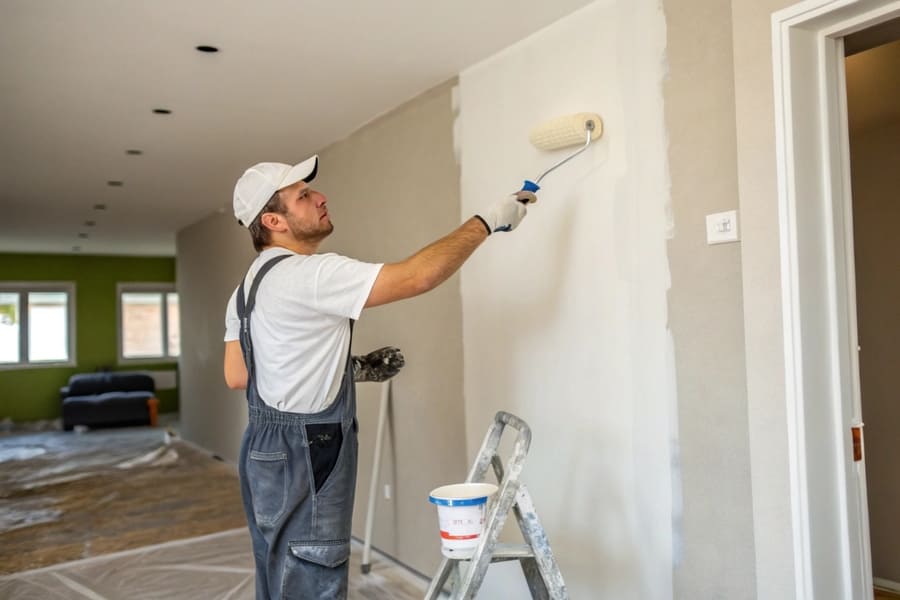
A commercial accent or feature wall is one of the highest-impact, lowest-cost interior design decisions available to facility managers and business owners — and one of the most technically demanding painting applications to execute correctly. Deep colors reveal every surface imperfection. Bold color boundaries demand precise cut-in at every edge. Patchy saturation from insufficient coat count or skipped tinted primer is visible from across the room and cannot be corrected with touch-ups. Facility360° Solutions provides full-scope commercial accent and feature wall painting for offices, restaurants, retail stores, medical facilities, and hospitality spaces across Greater Philadelphia — with on-site color consultation, correct surface preparation for saturated colors, and after-hours scheduling that delivers a sharp, finished feature wall before your space opens for business.
We carry deep-base and ultra-deep-base commercial interior coatings from Sherwin-Williams Emerald, Benjamin Moore Aura, and PPG Diamond — the commercial-grade, high-hide systems that deliver full saturation in two coats over a tinted primer, without the four-coat struggle that consumer-grade products require on deep colors.
The single preparation step most frequently skipped on commercial feature wall projects — and the one most responsible for poor deep-color results — is tinted primer. When a deep or saturated color is applied over a standard white primer, the white base reads through every imperfection in the topcoat coverage — producing a blotchy, uneven result that requires three or four finish coats to suppress. A primer tinted to 50–75% of the finish color eliminates this problem entirely: the first topcoat applies over a surface already close in value to the finish color, achieving uniform saturation in two coats rather than four. The tinted primer also allows accurate color preview before the finish coat is applied — catching any color accuracy issues before the final application, when corrections are still inexpensive. We specify tinted primer on every commercial feature wall project involving deep, saturated, or dramatically different colors from the existing wall surface. It adds one preparation step and saves two finish coats — and the result is visually and economically the correct approach.
Our commercial painting crew serves facilities throughout Greater Philadelphia — including Philadelphia, King of Prussia, Conshohocken, Bensalem, Willow Grove, Horsham, and surrounding communities. We carry deep-base and ultra-deep-base commercial interior systems on every project vehicle — with the tinted primer capability and color consultation expertise to execute feature walls in any color, at any depth, to a professionally finished standard.
A feature wall is a statement about your space — and about your standards. We make sure that statement is the right one.
Ready to add a feature wall to your commercial interior? Our crew serves Greater Philadelphia with on-site color consultation, correct deep-color preparation, after-hours scheduling, and written project documentation on every job.
Call now for a commercial accent and feature wall painting quote: (267) 992-1777 — or request a consultation online.
Others Services
Uneven color, ragged edges at the ceiling line, or patchy saturation on a bold accent wall are impossible to ignore — and impossible to fix without repainting the entire surface. We execute feature walls correctly from surface preparation through final coat, delivering the sharp, saturated result that makes the wall the focal point it was designed to be.
An effective commercial accent wall serves both a visual and a functional purpose — it draws attention to a specific zone, reinforces brand identity, or creates a distinct atmosphere in a defined area. Key principles for successful commercial accent wall design:
Single dominant surface — one wall per room or zone; applying bold color to multiple walls eliminates the focal point effect and overwhelms the space
Architectural logic — the most effective accent walls are surfaces that already carry visual weight — the wall behind a reception desk, the end wall of a corridor, the back wall of a restaurant bar, or the primary wall behind a boardroom table
Color selection relative to existing finishes — accent color must be assessed against the existing floor, ceiling, and furnishing colors under actual facility lighting, not from a paint chip under store lighting
Brand alignment — in corporate, retail, and hospitality environments, accent wall color is frequently derived from or complementary to brand color standards; we cross-reference brand color specifications in every commercial feature wall consultation
Sheen selection — accent walls in commercial interiors are typically specified in eggshell or satin — sufficient sheen to differentiate the feature surface from flat adjacent walls without creating glare or highlighting surface texture
Deep and saturated accent wall colors require more preparation and more coats than standard repaints — and shortcuts at any stage produce a visibly unacceptable result:
Tinted primer coat — the single most important step for deep color accuracy; a primer tinted to 50–75% of the finish color reduces topcoat coat count from three or four to two, achieves uniform color saturation, and eliminates the gray or muddy undertone that shows through an untinted white primer under dark topcoats
First finish coat — applied at correct spread rate after primer cure; deep colors frequently show blotchy, uneven coverage at one coat — this is normal and expected; do not assess color accuracy at one coat
Second finish coat — achieves full opacity and color accuracy in most deep color applications over a tinted primer; the standard commercial specification for feature walls
Third finish coat — required for very deep colors (black, navy, deep burgundy) over light existing surfaces where the tinted primer alone cannot suppress the existing color sufficiently
Rushing to two coats over a white primer on a deep accent wall produces a visually deficient result that requires complete repainting — not touching up — to correct.
Yes — geometric designs, color-block patterns, and two-tone feature walls are achievable in commercial interiors with the correct technique and materials:
Straight geometric lines — taped using Frog Tape Fine Line over a fully cured base coat; tape applied after the base color has dried for a minimum of 24 hours to prevent paint film damage on removal; second color applied, tape removed while the second color is still slightly wet to produce a clean, sharp edge
Diagonal and angled designs — measured and marked with a chalk line before taping; critical that the reference angle is established from a fixed architectural element (floor, ceiling, or door frame) rather than estimated visually
Two-tone color block — horizontal or vertical color division at a defined line; most common commercial application in reception areas, boardrooms, and hospitality dining areas; line placement must be established relative to adjacent furniture and fixture heights, not just wall center
Color wash and textured effects — achievable using specialty application techniques (rag roll, dry brush, glaze application) for hospitality and retail environments requiring a distinctive visual texture
Mural and branded graphics — we coordinate with graphic designers and signage suppliers for facilities requiring logo, branded graphic, or mural integration on feature wall surfaces
Feature walls require more rigorous surface preparation than standard wall repaints — because bold, saturated colors are visually unforgiving of surface irregularities:
Surface inspection under raking light — the feature wall surface is inspected with a raking light source (angled lamp held close to the surface) to reveal all irregularities before any preparation begins; surface defects invisible under normal lighting become prominent under a deep or saturated finish color
Skim coating — minor surface texture irregularities, trowel marks, and joint compound ridges are skim coated with drywall compound and sanded smooth before priming; feature wall surfaces should be as smooth as practical before a dark or saturated topcoat is applied
Spot repair and full surface fill — all nail holes, anchor holes, and surface damage filled and sanded flush; existing wall anchors removed and holes filled, not just covered
Tinted primer — as described above, primer tinted to 50–75% of the finish color applied at full-wall coverage before any topcoat; allows correct color evaluation before final coat application
Accent and feature walls deliver the highest visual and functional return in commercial spaces where first impressions, brand identity, and spatial definition matter most:
Corporate reception areas — the wall behind the reception desk is the first interior surface clients see; a well-executed feature wall in brand colors communicates identity and investment simultaneously
Conference and boardrooms — the presentation wall behind the head-of-table position benefits from a feature color that frames the space and anchors video call backgrounds
Restaurant and bar interiors — back bar walls, banquette walls, and host station walls are the natural feature surfaces in food service environments; saturated color or textured finish creates atmosphere in a high-impact location
Retail stores — product display walls, end-cap walls, and fitting room accent walls differentiate zones and direct customer attention to featured merchandise
Hotel lobbies and corridors — elevator lobby walls, corridor end walls, and check-in desk back walls are the natural accent locations in hospitality environments
Medical and wellness facilities — calming accent colors in patient waiting areas and consultation room feature walls contribute to patient comfort and brand differentiation in competitive healthcare markets
From everyday maintenance and upgrades to emergency repairs, Facility360° Solutions helps you plan, budget, and execute the work your commercial property needs to stay safe, efficient, and looking its best — with minimal disruption to your operations.
Request commercial service
Tell us what needs attention and we’ll get back to you with next steps.
Request commercial service
Tell us what needs attention and we’ll get back to you with next steps.