From Butler Avenue boutique retail and Ridge Hall food vendors to century-old mixed-use buildings near the SEPTA station and the restaurant rows surrounding Ambler Theater — Facility360° delivers a single-vendor facility support program that handles every routine repair, inspection, and coordination task across downtown commercial properties.
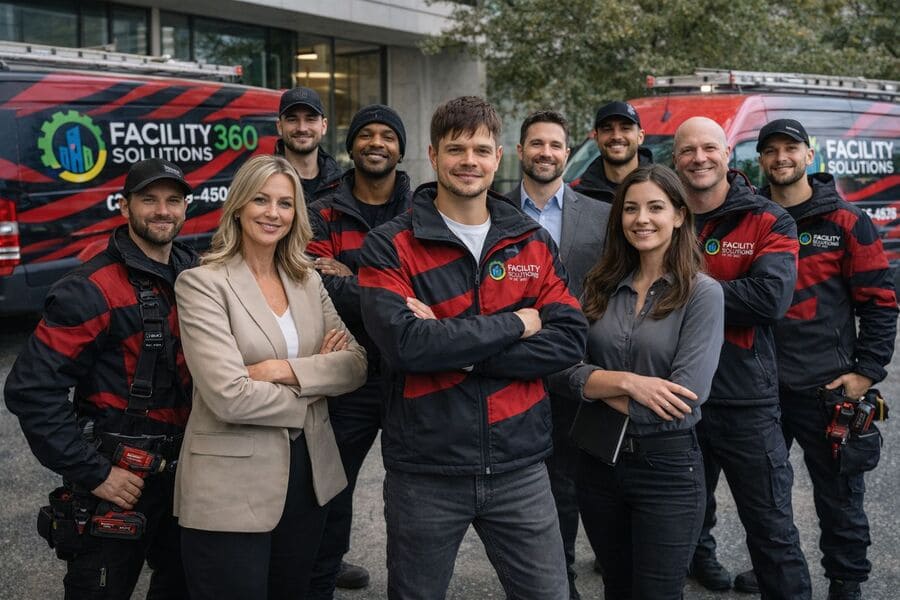
Ambler is one of Montgomery County’s most active walkable downtowns — a Borough of roughly 6,400 residents inside ZIP 19002, recognized by The Philadelphia Inquirer as a “destination town” and built around a commercial core that runs on a tight mix of restaurants, boutiques, theatres, food halls, professional offices, and mixed-use buildings dating back to the late 1800s. For the property managers, building owners, and small commercial landlords who run these blocks, the maintenance workload accumulates in a way that doesn’t fit a single trade. A boutique storefront needs door hardware tuned and signage remounted in the same week a restaurant tenant requests a drywall patch and a touch-up repaint, while the mixed-use building one block over is overdue for an inspection that nobody scheduled. The default solution — calling a different contractor each time — burns the property manager’s week on coordination and leaves quality inconsistent across the portfolio.
Facility360° Solutions is a licensed Pennsylvania commercial contractor that replaces that contractor-juggling with a single facility support program. One account manager. One billing cycle. Scheduled service windows with written reporting after every visit. Same-day response for urgent issues, 24-hour response for standard requests, and proactive identification of problems before they escalate into emergency calls.
The facility support program is designed for property managers and commercial owners who need a single, reliable partner across all routine and recurring maintenance:
Clients moving to an active facility support program typically see a 40–60% reduction in unplanned maintenance calls within the first year, a meaningful drop in tenant complaints about repair quality, and a maintenance budget that becomes predictable enough to plan against rather than absorb as a variable cost.
The commercial inventory along Butler Avenue, Main Street, and the side blocks running off the downtown core is dominated by buildings constructed between roughly 1880 and 1920 — late-Victorian stone construction, brick rows from the early 1900s, and converted mill-era structures from the borough’s industrial heritage. These buildings carry a maintenance reality that’s different from purpose-built modern commercial space: galvanized and copper supply lines well past their service life, knob-and-tube or early grounded electrical retrofitted in layers over the decades, plaster substrates that hide small problems behind decorative trim, shared party walls between tenant units, and a Borough historic-aesthetic ordinance that governs what can be done to facades during repair work. The maintenance program that works in a freestanding office building doesn’t translate directly into this environment. Scheduled inspections need to know what to look for in older construction. Drywall and paint work needs to handle plaster, decorative mouldings, and original trim alongside modern partition walls. Door and hardware servicing needs to work with both original entry doors and modern storefronts. And the documentation back to the building owner needs to capture the condition of historic elements alongside standard maintenance items.
Our crews work routinely across this kind of downtown building stock — from the Butler Avenue retail blocks through the side streets, including the office and restaurant rows near Ambler Theater and Act II Playhouse, the food-hall and brewery footprint at Ridge Hall, and the mixed-use buildings stretching toward Temple University’s local campus. The assessment-first approach is the starting point for every new client: a complete property walkthrough documents existing condition, identifies deferred-maintenance items specific to older buildings, builds an asset inventory across tenant spaces and common areas, and produces a photographic baseline for future reference. The goal isn’t to run more service calls — it’s to run fewer, with each one planned, documented, and resolved on the first visit.
Nearby areas: Dresher · North Hills · Maple Glen · Jarrettown · Upper Dublin · Whitemarsh · Spring House · Penllyn
Also serving: Horsham · Plymouth Meeting · Willow Grove · Blue Bell · Fort Washington
✓ Single Point of Contact
✓ Historic Building Experience
✓ Scheduled Service + Written Reporting
✓ Proactive, Not Just Reactive
One Partner. Every Repair. Total Facility Control.
Keep your downtown commercial property maintained, professional, and fully operational — with one reliable team handling every repair, inspection, and maintenance task. From Butler Avenue to Main Street and the surrounding mixed-use blocks, we cover it all.
OUR WORK IN AMBLER
In Ambler’s walkable historic downtown, restaurants operate in character-rich buildings — Victorian storefronts and former mill spaces that need upkeep matched to their age and foot traffic. See how we keep a downtown Ambler restaurant guest-ready with local handyman and facility support, handled by one contractor. Review the scope, the work performed and the outcome.
Yes, and in many ways the value is higher in older buildings than in modern construction. Older commercial properties accumulate deferred-maintenance items quietly — small water marks behind plaster, hairline cracks at trim joints, hardware that's been adjusted into compliance rather than properly serviced, electrical that's been retrofitted in layers. A scheduled inspection program catches those items during planned walkthroughs and addresses them before they become the kind of repair that requires shutting the tenant down for a week. The reporting also becomes a paper trail of the building's condition over time, which matters when ownership changes, when refinancing happens, or when an insurance claim references prior condition.
No. The program scopes to the property, not the other way around. For a single storefront or a two-tenant mixed-use building, that might mean a monthly inspection rather than a bi-weekly one, a smaller hour-bank for routine repairs, and a simpler reporting cadence — but the same core structure applies: one point of contact, scheduled service, written documentation, and preferred response when something does come up. The single-storefront landlord usually gets the most operational relief from this model because they're handling everything themselves between the property and a day job; replacing five sporadic contractor relationships with one program changes how the week actually runs.
No, and it shouldn't be replaced. Restaurant tenants typically run vendor relationships that are tied to their operating permits, food-safety inspections, and equipment warranties — hood cleaning on a regulated schedule, pest control on a documented cadence, HVAC on manufacturer service contracts. The facility support program runs in parallel with those, handling the landlord-side maintenance scope: common areas, structural repairs, exterior maintenance, signage, door and hardware, the building envelope. Where landlord and tenant scopes overlap or hand off, we coordinate so the tenant's operational vendors and our landlord-side program don't trip over each other.
It affects scheduling and crew sizing, but not whether the program works. Routine and preventive work is scheduled into windows that fit the building's access reality — early morning before retail opens, evenings after restaurant service, scheduled days when delivery access aligns. Crews stage from the closest legal access point and use equipment scaled to walkable downtown logistics rather than truck-back-door commercial. For work that requires longer access or storefront closure, we plan with the tenant and landlord in advance rather than showing up and discovering the constraint at the door. This is one of the operational pieces where downtown-specific experience matters; a contractor sized for office-park work tends to handle this poorly.
Pricing is built around three variables: property size and tenant count, the frequency of scheduled service, and the scope included in the program versus billed on demand. Most downtown commercial properties at the single-building or small-portfolio scale run on a fixed monthly retainer covering scheduled inspections, preventive maintenance, and a defined hour-bank for routine repairs, with anything outside that scope billed at preferred rates and approved in advance. Monthly reporting shows the work performed, hours used against the bank, items deferred, and the running condition status of the property. No surprise invoices, no item that wasn't discussed before it happened. The starting point is always a free on-site assessment with a written program proposal scaled to the property's actual reality.
Let’s keep your business facility one step ahead
One call schedules your free on-site assessment — a complete property walkthrough with a written program proposal. Covering downtown retail, restaurants, and mixed-use buildings across the Borough.
Request Your Free Estimate
Serving Greater Philadelphia, PA
Your single point of contact for 24/7 facility management and all handyman services
Signup our newsletter to get update information, news and insight
Request commercial service
Tell us what needs attention and we’ll get back to you with next steps.
Request commercial service
Tell us what needs attention and we’ll get back to you with next steps.