
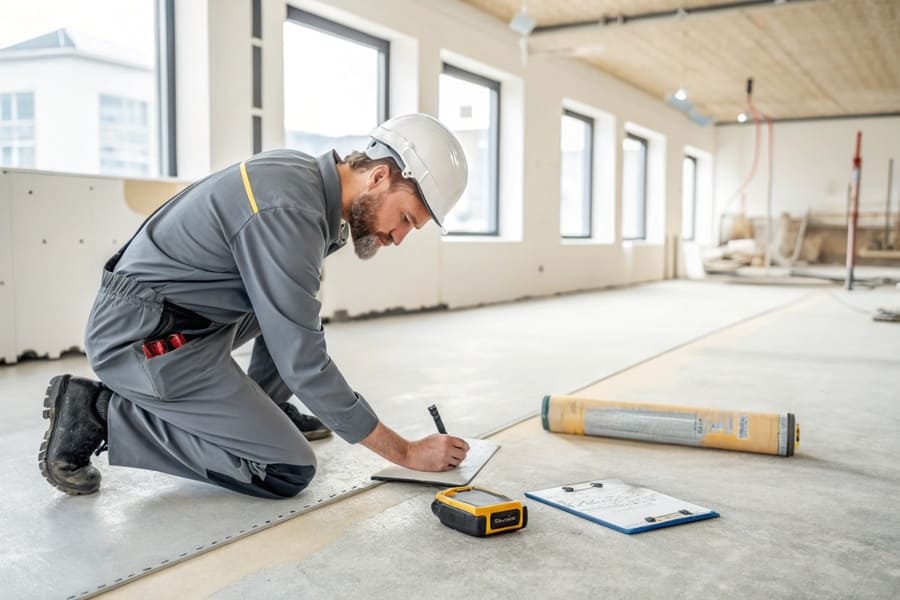
Moisture vapor emission from concrete slabs is the leading cause of commercial flooring failure in Greater Philadelphia — and the most consistently underestimated risk in commercial flooring projects. Every concrete slab releases moisture vapor continuously throughout its service life. That vapor attacks flooring adhesive bonds, causes LVP planks to buckle and tent, drives epoxy coatings to delaminate, and softens VCT adhesive until tiles lift under foot traffic. The failure is always attributed to the flooring — but the cause is always the untested, unmitigated slab beneath it. Facility360° Solutions provides full-scope commercial moisture control and mitigation services for offices, warehouses, restaurants, medical facilities, and retail spaces across Greater Philadelphia — performing ASTM-certified moisture testing, identifying moisture sources, applying commercial-grade mitigation systems, and providing complete test and product documentation for flooring system warranty validation.
We do not recommend mitigation systems without quantified test data. We do not apply topical barriers without identifying the moisture source. And we do not allow flooring installation to proceed over any slab that has not been tested and brought within the specific moisture tolerance limits of the flooring system being installed.
We provide the complete scope of commercial concrete slab moisture assessment, mitigation, and documentation, including:
Greater Philadelphia’s geology and climate create above-average moisture vapor risk for commercial concrete slabs. The region sits on a mix of clay-rich soils and weathered rock that retain groundwater at elevated levels — particularly in the spring and early summer months when snowmelt and rainfall combine with already-saturated soils. Below-grade and slab-on-grade commercial buildings throughout Philadelphia, King of Prussia, Conshohocken, and the surrounding communities are subject to seasonal groundwater elevation that drives moisture vapor emission rates well above flooring manufacturer limits during peak periods. Older commercial buildings constructed before modern below-slab vapor retarder standards were established — pre-1980s construction — frequently lack any below-slab vapor control whatsoever. Every commercial flooring installation in Greater Philadelphia should begin with moisture testing. In below-grade and older construction, mitigation should be assumed until testing proves otherwise.
Our moisture control and mitigation crew serves commercial facilities throughout Greater Philadelphia — including Philadelphia, King of Prussia, Conshohocken, West Chester, Bensalem, Willow Grove, Horsham, Pottstown, and surrounding communities. We carry calibrated ASTM F2170 RH probe equipment, calcium chloride test kits, diamond grinding equipment, and commercial moisture barrier systems from Ardex, Mapei, Laticrete, and Sika on every project — performing testing and mitigation under one contract without subcontracting any phase of the work.
Concrete moisture is invisible until your flooring fails — and by the time it fails, the cost of remediation is three to five times the cost of testing and mitigation that would have prevented it. We test every slab, mitigate every exceedance, and document everything — so the flooring installed over our work performs for its full warranted service life.
Don’t install new commercial flooring over an untested concrete slab. Our moisture control and mitigation crew serves Greater Philadelphia with ASTM-certified testing, source identification, commercial barrier application, and complete warranty documentation — before the first piece of flooring goes down.
Call now to schedule commercial moisture testing and mitigation: (267) 694-4508 — or request a site assessment online.
Concrete releases moisture vapor throughout its service life — and the slab that tests clean in August may fail your flooring by April. We test to ASTM standards, mitigate to specification, and document everything your flooring warranty requires — before installation begins.
ASTM F1869 calcium chloride test measures surface moisture vapor emission rate in lbs per 1,000 sq ft per 24 hours — acceptable limit typically ≤3 lbs. ASTM F2170 relative humidity probe test measures RH within the slab at 40% depth — acceptable limit typically ≤75–80% RH. Both tests are required by most major flooring manufacturers for warranty validation. We perform and document both on every project.
Primary causes include missing or failed below-slab vapor retarder, hydrostatic pressure from high seasonal groundwater, new concrete cure water not yet dissipated, plumbing leaks below the slab, HVAC condensation on cold piping, and exterior drainage directing surface water toward the foundation. Source identification determines whether topical mitigation or structural remediation is required.
Two-component epoxy moisture barrier (Ardex MC, Mapei Planiseal EMB, Laticrete Hydro Ban) reduces MVER to ≤3 lbs and RH to ≤75% for MVER up to 20 lbs. Moisture-tolerant primer allows adhesive performance at elevated levels without reducing emission. Polyurethane injection treats localized hydrostatic intrusion through cracks. We specify the system based on test results and the flooring system to be installed.
Spring groundwater peaks drive the highest MVER readings of the year — flooring installed in spring over under-mitigated slabs has the highest failure rate. Summer readings are typically lowest, creating a false sense of adequacy for installations that fail the following spring. We test at current conditions and specify mitigation rated for peak seasonal emission levels — not just the test-day result.
No. Most sensitive: hardwood, VCT, and glue-down LVP/LVT at maximum 3–5 lbs MVER. Moderately sensitive: ceramic tile and carpet. Most tolerant: click-lock LVP/LVT (floating, not bonded) and epoxy coatings with moisture-tolerant primer rated up to 15–20 lbs MVER. We assess your specific flooring system's moisture tolerance alongside slab test results.
From everyday maintenance and upgrades to emergency repairs, Facility360° Solutions helps you plan, budget, and execute the work your commercial property needs to stay safe, efficient, and looking its best — with minimal disruption to your operations.
Philadelphia, King of Prussia, Bensalem, Perkasie, Conshohocken, West Chester, Reading, Willow Grove, Plymouth Meeting, Horsham, Pottstown, Morgantown, Allentown, Pittsburgh.
Serving Greater Philadelphia, PA
Your single point of contact for 24/7 facility management and all handyman services
Signup our newsletter to get update information, news and insight